 Writer
Ling Kesar — The Story of ‘aBruguma’s Marriage to Kesar
Region: Ladakh, Lower Ladakhi tradition
Tradition: Kesar / Gesar epic
Story type: Epic / heroic legend / marriage tale
Main figures: Kesar, Duguma (‘aBruguma), the people of Ling
Previous chapter: Kesar’s Childhood and the Making of the Hero
Next chapter: Kesar’s Journey to China
Kesar Saga Chapters
- The Prologue to the Kesar Saga
- The Birth of Kesar
- Kesar’s Childhood and the Making of the Hero
- The Story of ‘aBruguma’s Marriage to Kesar
- Kesar’s Journey to China
- Kesar’s Marriage to gYui dKon mChogmo
- The Northern Giant
- The Capture of ‘aBruguma by the King of Hor
- The Defeat of the King of Hor
This sequence forms the principal structural basis for this website series.
Short Excerpt
Kesar had been born under extraordinary signs and had grown into a young man unlike other men.
But becoming a hero was not the only destiny awaiting him.
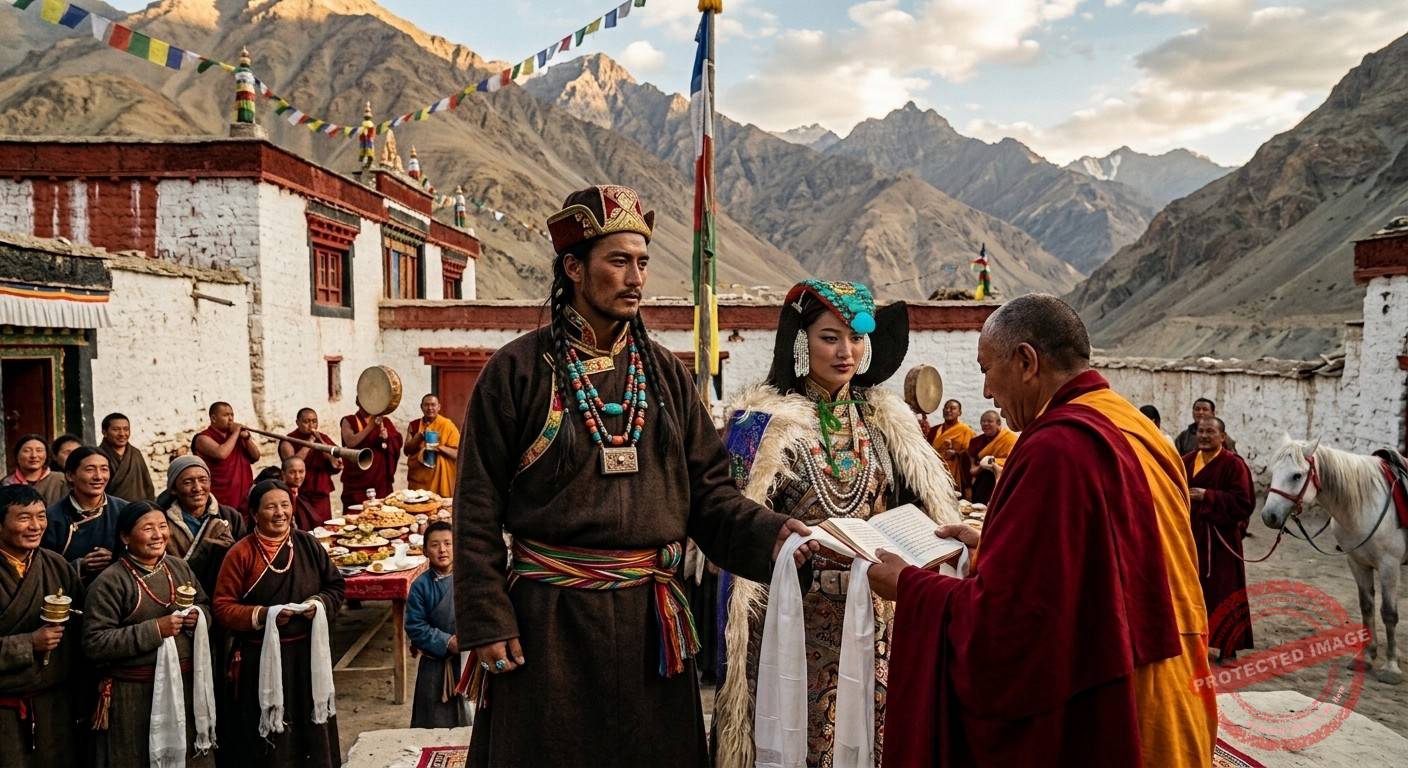
The next great turning point in his life was his marriage to Duguma, known in the Lower Ladakhi tradition as ‘aBruguma.
Their marriage was more than a domestic event. It became one of the central relationships of the entire Kesar epic—a relationship that would later be tested by separation, captivity, war and reunion.
Before Kesar could become the great warrior remembered in the later songs, he had to enter a world of family, marriage and kingship.
And it was through Duguma that another chapter of his destiny began.
Kesar Comes of Age
The young Kesar had already shown that he was different from ordinary men.
His birth had been surrounded by miracles.
His childhood had brought him into contact with supernatural beings.
The land of Ling had become associated with his destiny.
But a hero cannot remain a child forever.
As Kesar grew older, his life began to move toward the responsibilities of adulthood.
In the traditional narrative, marriage becomes one of the great transitions in his life.
The woman who enters his story is Duguma.
Her name appears in different spellings depending on the source and transcription. Francke’s Lower Ladakhi version gives the form ‘aBruguma, while modern English writing about the Kesar tradition commonly renders the name as Duguma.
For this website, both forms are retained so that readers can connect the story with the historical sources.
Who Is Duguma?
Duguma is not simply a secondary character in the Kesar story.
She becomes one of its central figures.
Her relationship with Kesar provides the emotional thread connecting several major sections of the epic.
The later story depends upon their separation.
Duguma is eventually taken away from Kesar and becomes associated with the kingdom of Hor.
Kesar’s response to her disappearance leads to one of the great military episodes of the epic.
Thus, the marriage described in this chapter is also the beginning of a much larger story.
The joy of marriage will eventually be followed by separation.
Separation will lead to conflict.
Conflict will lead to war.
And war will ultimately bring Kesar face to face with the King of Hor.
The Meeting
The surviving Lower Ladakhi material does not read like a modern romantic novel.
It is an epic.
Its emphasis is on kingship, lineage, journeys, supernatural events and great deeds.
Consequently, the story of Kesar and Duguma should be understood within the larger world of heroic storytelling rather than through the conventions of a modern love story.
Kesar’s marriage is part of his transformation into a ruler.
Duguma becomes part of the household and destiny of Ling.
Their union strengthens the connection between the hero’s personal life and the political world around him.
The exact details of their meeting and courtship can vary in retellings and regional versions, and the website should therefore avoid inventing conversations or scenes that are not supported by a particular source.
What matters in the traditional sequence is that Kesar and Duguma become husband and wife and that their relationship becomes central to the later epic.
Duguma Enters Ling
With the marriage, Duguma becomes associated with Ling and with Kesar’s royal household.
The story now begins to change character.
The miraculous child of the earlier chapters has become a grown man.
His destiny is no longer only his own.
He now has a family and a kingdom to protect.
The responsibilities of kingship begin to take shape.
In heroic epics, marriage frequently marks the point at which a young hero becomes responsible for something larger than himself.
The same pattern can be seen here.
Kesar’s world is no longer simply about his own adventures.
It includes Duguma.
It includes Ling.
And eventually it will include kingdoms far beyond Ladakh.
The Meaning of Their Marriage
The marriage of Kesar and Duguma is important for another reason.
The Kesar epic is not only a sequence of battles.
At its heart is a story about relationships and loss.
Kesar’s later campaigns are motivated not simply by the desire to conquer territory.
The fate of Duguma becomes one of the forces that drives him into conflict with Hor.
This gives the later war a personal dimension.
The king is not fighting only for his kingdom.
He is fighting to recover someone who belongs to his household.
The relationship therefore connects the private and political worlds of the epic.
A Hero’s Household
The traditional Kesar stories gradually build a large network of people around the central hero.
Kesar is surrounded by relatives, allies, warriors, supernatural beings and rulers of distant lands.
Duguma stands at the centre of his household.
Her presence makes Ling more than a warrior’s kingdom.
It becomes a home.
This distinction becomes important later.
When Duguma is taken away, what Kesar loses is not merely a person.
He loses part of the world he has built.
The journey that follows therefore becomes both a military campaign and a personal quest.
From Marriage to Journey
Kesar’s marriage to Duguma does not bring the epic to a peaceful conclusion.
Instead, it becomes a stage before another great movement.
The Lower Ladakhi narrative recorded by Francke proceeds from the story of Kesar’s marriage to his journey to China.
There he encounters another royal world and marries gYui dKon mChogmo, whose name appears in Francke’s transcription.
This episode demonstrates the enormous geographical imagination of the Kesar epic.
The hero of Ling does not remain confined to one valley.
His story moves across distant kingdoms.
He encounters foreign rulers, different peoples and supernatural enemies.
The world of the epic becomes much larger.
Duguma’s Future
The significance of Duguma’s marriage becomes clearer only when the later story unfolds.
Duguma will eventually be captured by the King of Hor.
That event becomes one of the great crises of the epic.
Kesar’s response is decisive.
He gathers his forces and prepares for confrontation with Hor.
The war that follows is not an isolated adventure.
Its emotional foundation was established here, when Kesar and Duguma first became husband and wife.
This is why the marriage belongs near the beginning of the Kesar story.
It creates a relationship whose loss will eventually set the epic’s greatest conflict into motion.
The Woman at the Centre of the Epic
In many heroic traditions, the wife or companion of the hero can disappear into the background once the battles begin.
Duguma’s role is more significant.
Although different versions give her different degrees of prominence, her fate remains closely connected with the movement of the story.
She is not merely the person Kesar marries before going on adventures.
She becomes part of the reason the later adventure happens.
Her captivity transforms the hero’s personal grief into political action.
This is one of the reasons Duguma deserves to be treated as a major figure in the Ladakhi Kesar tradition rather than simply as Kesar’s wife.
The Oral Epic and Changing Details
It is important to remember that Kesar was traditionally transmitted orally.
A storyteller could emphasize different episodes, characters and details depending on locality, audience and storytelling tradition.
Consequently, modern readers may encounter different accounts of:
- Kesar’s birth
- his childhood
- his relationship with Duguma
- the circumstances of their marriage
- the identity and role of other characters
- his journeys
- the war with Hor
These differences should not automatically be treated as contradictions.
They are part of the history of an oral epic.
The Ladakh Studies archive notes that Kesar exists in multiple local versions and that the epic can take several days to tell.
For the website, each substantial variation should eventually be identified by region, storyteller or published source, wherever that information is available.
The Lower Ladakhi Version
A. H. Francke’s A Lower Ladakhi Version of the Kesar-Saga, published in 1909, provides one of the most important written records of a Ladakhi form of the epic.
His contents place the story of ‘aBruguma’s marriage to Kesar immediately after the birth material.
The subsequent sections include Kesar’s journey to China, his marriage there, the northern giant, the capture of ‘aBruguma by the King of Hor and the eventual defeat of Hor.
This sequence is important because it shows that Duguma’s marriage is not an isolated tale.
It is structurally connected to the major events that follow.
From Home to the Wider World
The marriage marks the end of one stage of Kesar’s life.
Until now, the story has been concerned primarily with his miraculous origins and development.
Now the horizon expands.
Kesar will leave the immediate world of Ling.
He will encounter distant kingdoms.
He will face supernatural challenges.
He will marry again.
He will experience separation.
And eventually he will return to confront the enemies who threaten his household.
The young hero is becoming the great Kesar of the epic.
A Marriage Before the Storm
The story of Kesar and Duguma can therefore be understood as the calm before one of the great storms of the epic.
There is a kingdom.
There is a king.
There is a wife.
There is a home.
But the wider world is waiting.
The next journey will take Kesar far beyond Ling.
And when he returns, his kingdom and his family will no longer be the same.
The marriage that began with hope will eventually become the reason for one of the greatest wars in the Kesar tradition.
Cultural Context
Marriage occupies an important position in the Kesar epic because the story repeatedly connects family, kingship and political responsibility.
Kesar is not presented simply as an individual adventurer.
He is a ruler whose personal relationships have consequences for his kingdom.
Duguma’s later capture demonstrates this relationship between private and public life.
The fate of one member of the royal household becomes the cause of a major political and military confrontation.
This is characteristic of heroic epic storytelling, where the lives of rulers and their families are closely connected to the fate of entire kingdoms.
The Kesar tradition also differs from a conventional historical chronicle.
It contains supernatural beings, miraculous births, extraordinary journeys and legendary battles.
The story should therefore be presented on the website as folklore and epic tradition, while historical information about actual places, rulers or political relationships should be separately identified and sourced.
Versions and Variations
The name of Duguma varies considerably in transcription.
Francke uses ‘aBruguma in his Lower Ladakhi publication.
Other modern sources commonly use Duguma, Drukmo, Dugmo or related forms.
Readers should not assume that every spelling represents a different character.
The same problem occurs with the hero’s name, which can appear as Kesar, Gesar, Gesar of Ling, Ling Kesar, or Ling Norbu Dadul, depending on linguistic and regional context.
The exact details of Kesar’s relationship with Duguma also vary across versions.
For this reason, this website page follows the Lower Ladakhi framework rather than combining Tibetan, Ladakhi and modern retellings into one supposedly definitive narrative.
Source Notes
Primary source
A. H. Francke, A Lower Ladakhi Version of the Kesar-Saga, Calcutta, 1909.
Francke’s contents place “The story of ‘aBruguma’s marriage to Kesar” after the birth section. The following sections cover Kesar’s journey to China, his marriage to the Chinese princess, the northern giant, the capture of ‘aBruguma by the King of Hor and the defeat of Hor.
Oral tradition
The Kesar epic was traditionally transmitted through storytelling rather than through one fixed canonical book. Accounts of Ladakhi storytelling emphasize that different regions preserve different versions and that Kesar narratives can be performed over several days.
Editorial note
This page is a website-oriented English retelling, not a literal translation of Francke’s Tibetan text.
Where the source establishes the sequence of events, that sequence has been retained. Narrative transitions have been written in modern English for readability and are not presented as quotations from a traditional storyteller.
Where versions differ, the variation is identified rather than silently combined.
What Comes Next
Kesar’s marriage to Duguma establishes one of the most important relationships in the entire saga.
But the hero’s destiny cannot remain within Ling.
The next stage of the story takes Kesar beyond his homeland and into a distant world traditionally associated with China.
There he will encounter another royal household and gYui dKon mChogmo, whose story becomes part of the expanding world of Kesar’s adventures.
The saga now moves from marriage in Ling to Kesar’s journey beyond his homeland.
Chapter Navigation
Previous Chapter:
Ling Kesar — Kesar’s Childhood and the Making of the Hero
Next Chapter: