 Writer
Region: Ladakh / Western Tibet
Tradition: Ling Kesar Saga
Story type: Heroic epic / oral legend
Main figure: Kesar of Ling
Source version: Lower Ladakhi version recorded and published by A. H. Francke
Kesar Saga Chapters
- The Prologue to the Kesar Saga
- The Birth of Kesar
- Kesar’s Childhood and the Making of the Hero
- The Story of ‘aBruguma’s Marriage to Kesar
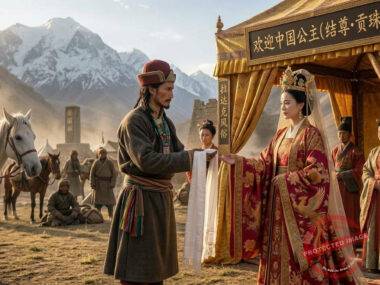
- Kesar’s Journey to China
- Kesar’s Marriage to gYui dKon mChogmo
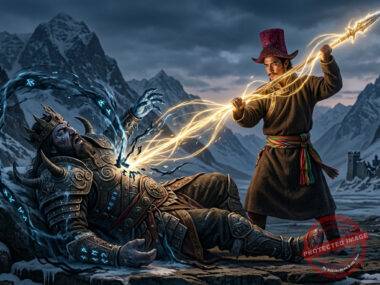
- The Northern Giant
- The Capture of ‘aBruguma by the King of Hor
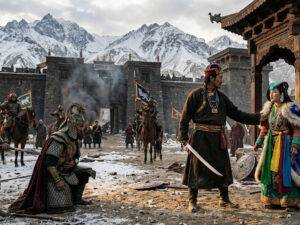
- The Defeat of the King of Hor
This sequence forms the principal structural basis for this website series.
Short Excerpt
The Kesar Saga belongs to a world where history, legend, memory, landscape, and the supernatural are woven together. Across the Tibetan cultural world, the name of Kesar is associated with the kingdom of Ling and with a hero whose journeys carry him across distant lands and into conflicts between kings, warriors, spirits, and forces beyond the ordinary world.
In the Ladakhi tradition, Kesar is remembered not simply as a warrior but as a heroic figure whose story has been preserved through oral narration. The opening of the saga establishes the world into which he is born: a world of kings and kingdoms, extraordinary beings, destiny, conflict, and a landscape in which the human and supernatural realms remain closely connected.
The Story
The story of Ling Kesar begins before the hero himself enters the centre of the narrative.
The world of the Kesar Saga is already populated by kingdoms, rulers, warriors, supernatural beings, and communities whose lives are shaped by forces larger than themselves. Among these is the kingdom of Ling, the land with which Kesar becomes inseparably associated.
Ling is not presented merely as a geographical place. Within the epic tradition it becomes the centre of Kesar’s royal identity and the stage from which his heroic life unfolds.
The prologue therefore serves an important purpose. It prepares the listener for a story in which ordinary human life and extraordinary events exist side by side.
The coming of Kesar is not treated as the arrival of an ordinary prince.
His birth, childhood, battles, marriages, journeys, and encounters with supernatural forces form part of a larger heroic order. The events that follow are understood through this wider world.
The World of Ling
Ling stands at the heart of the Kesar tradition.
The kingdom is associated with its rulers, its people, its warriors, and its relationship with neighbouring lands. In the epic imagination, Ling is both a political kingdom and a symbolic homeland.
The idea of a kingdom in the Kesar Saga is broader than the territory ruled by a historical monarch. It represents community, authority, loyalty, family, protection, and the responsibilities of a ruler.
Kesar’s connection with Ling therefore becomes central to his identity.
He is Kesar of Ling not simply because he belongs to a particular place, but because his heroic destiny becomes inseparable from the protection and continuation of that world.
The Coming of the Hero
The prologue prepares the ground for the appearance of the hero.
In oral epic traditions, the beginning of a heroic story often establishes the extraordinary nature of the events that are about to unfold. The audience is introduced to the world, its dangers, its rulers, and its expectations before the hero’s life becomes the central concern.
The Kesar tradition follows this broader pattern.
The hero who emerges from the story is destined to encounter challenges that extend far beyond the ordinary concerns of a single kingdom. His enemies include powerful rulers and supernatural beings, while his journeys take him into distant lands.
The scale of the story gradually expands.
What begins with the world of Ling eventually reaches other kingdoms and regions, including the lands associated in the epic with China and Hor.
The Heroic Order
Kesar’s world is one in which strength carries responsibility.
A hero is not defined only by victory in battle. He is also connected with protection, justice, loyalty, kingship, and the preservation of order.
This becomes an important theme throughout the saga.
Kesar’s conflicts are therefore not simply personal contests. They frequently become struggles involving kingdoms, families, marriage alliances, honour, and the security of his people.
The heroic figure stands between order and disorder.
This is one reason the Kesar Saga has remained powerful within oral traditions. The hero’s adventures can be understood at several levels: as stories of courage, as royal legends, as tales of supernatural encounters, and as reflections on the responsibilities of power.
Oral Tradition and the Prologue
The Kesar Saga has been transmitted for generations through oral performance.
Different communities and regions preserve different portions and versions of the larger tradition. Details of characters, places, events, and the order of episodes may therefore differ between tellings.
The Lower Ladakhi version recorded by A. H. Francke represents one important written record of this living oral tradition.
Francke’s work does not represent the entirety of the Kesar tradition. Rather, it provides a valuable record of a particular Ladakhi version and its sequence of episodes.
The prologue should therefore be understood within this tradition of oral storytelling.
It establishes the setting and prepares the listener for the larger cycle of events that follows.
The Beginning of a Larger Story
The opening of the saga is only the beginning.
After the prologue comes the story of Kesar’s birth and the extraordinary circumstances surrounding his arrival in the world. His childhood then reveals further signs of the hero he will become.
From there, the story expands into marriage, journeys, encounters with supernatural enemies, conflicts between kingdoms, and the defence of Ling.
The narrative gradually moves outward from the hero’s origins toward the wider world.
This expansion is one of the defining features of the Kesar tradition.
Kesar’s life is never confined to one village or one kingdom. His destiny carries him across a much larger epic landscape.
Kesar and the Idea of Destiny
The Kesar Saga is deeply concerned with destiny.
The hero’s life is presented as part of a larger order in which extraordinary events are not accidental. His birth, his abilities, his relationships, and his conflicts all contribute to the fulfilment of a larger heroic role.
Yet destiny in the epic does not remove the importance of action.
Kesar must still travel, confront enemies, protect others, and face the consequences of his decisions.
The hero therefore represents both destiny and action.
His greatness is expressed not merely through what is foretold about him, but through what he does when confronted by danger and responsibility.
Versions and Variations
The Kesar Saga exists in numerous oral and literary versions across the Tibetan cultural world.
Ladakh itself preserves different traditions of the epic, and individual storytellers may emphasise different episodes or characters. Names, geographical descriptions, supernatural beings, and sequences of events can vary.
The Lower Ladakhi version recorded by A. H. Francke is one such version.
Because the saga is fundamentally rooted in oral tradition, variations should not automatically be treated as contradictions. They are part of the history of how the epic has been remembered, performed, adapted, and transmitted.
For this website series, the chapter sequence follows the Lower Ladakhi tradition associated with Francke while recognising the wider diversity of Kesar traditions.
Cultural Context
The Kesar tradition belongs to a broader Himalayan and Tibetan world in which oral storytelling has played an important role in preserving cultural memory.
Epic narratives could transmit ideas about kingship, courage, loyalty, family, justice, supernatural power, and the relationship between people and the wider world.
In Ladakh, such traditions form part of a rich body of oral folklore.
The Kesar Saga is especially significant because of its scale. It connects local landscapes and communities with an enormous heroic world extending across kingdoms and distant regions.
The story therefore functions not only as entertainment but also as a cultural memory.
Through the hero of Ling, generations of listeners encountered ideas about power, duty, conflict, protection, and the consequences of disorder.
Source Note
This chapter follows the Lower Ladakhi Kesar tradition documented by A. H. Francke in A Lower Ladakhi Version of the Kesar-Saga: Tibetan Text, Abstract of Contents, Notes and Vocabulary of the New Words and Phrases, published in Calcutta in 1909.
Francke’s work is an important early written record of a Ladakhi version of the Kesar epic. His text should be understood as documentation of a particular oral tradition rather than as a definitive version of the entire Kesar Saga.
The wider Kesar tradition contains many regional and oral variations.
What Comes Next
The next chapter moves from the world established in the prologue to the extraordinary circumstances surrounding the birth of Kesar.
The story now turns from the kingdom of Ling and the heroic world around it to the arrival of the figure whose life will become the centre of the saga.
Chapter Navigation
Next Chapter: