 Writer
Region: Ladakh, particularly the Lower Ladakhi tradition
Tradition: Kesar / Gesar epic
Story type: Epic / heroic legend / marriage tale
Main figure: Kesar of Ling; gYui dKon mChogmo
Previous chapter: Kesar’s Journey to China
Next chapter: The Northern Giant
Kesar Saga Chapters
- The Prologue to the Kesar Saga
- The Birth of Kesar
- Kesar’s Childhood and the Making of the Hero
- The Story of ‘aBruguma’s Marriage to Kesar
- Kesar’s Journey to China
- Kesar’s Marriage to gYui dKon mChogmo
- The Northern Giant
- The Capture of ‘aBruguma by the King of Hor
- The Defeat of the King of Hor
This sequence forms the principal structural basis for this website series.
Short Excerpt
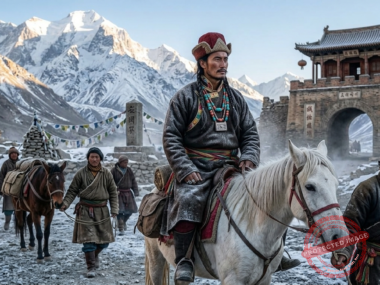
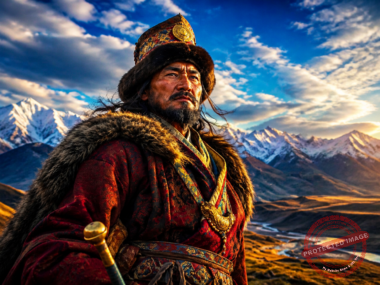
Kesar had travelled beyond the world of Ling and reached toward the distant kingdom of China.
But the journey was not simply a journey across mountains and foreign lands.
It was a test of Kesar’s supernatural power, patience and determination.
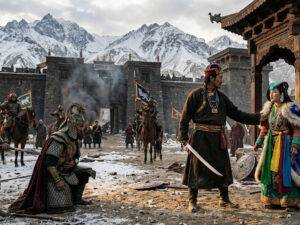
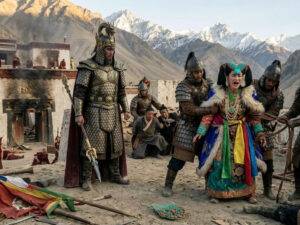
After completing his time at the hermitage, Kesar entered the wider world of China and came into contact with its king and royal household.
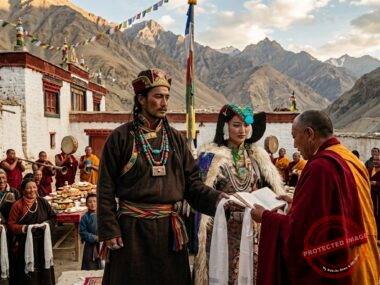
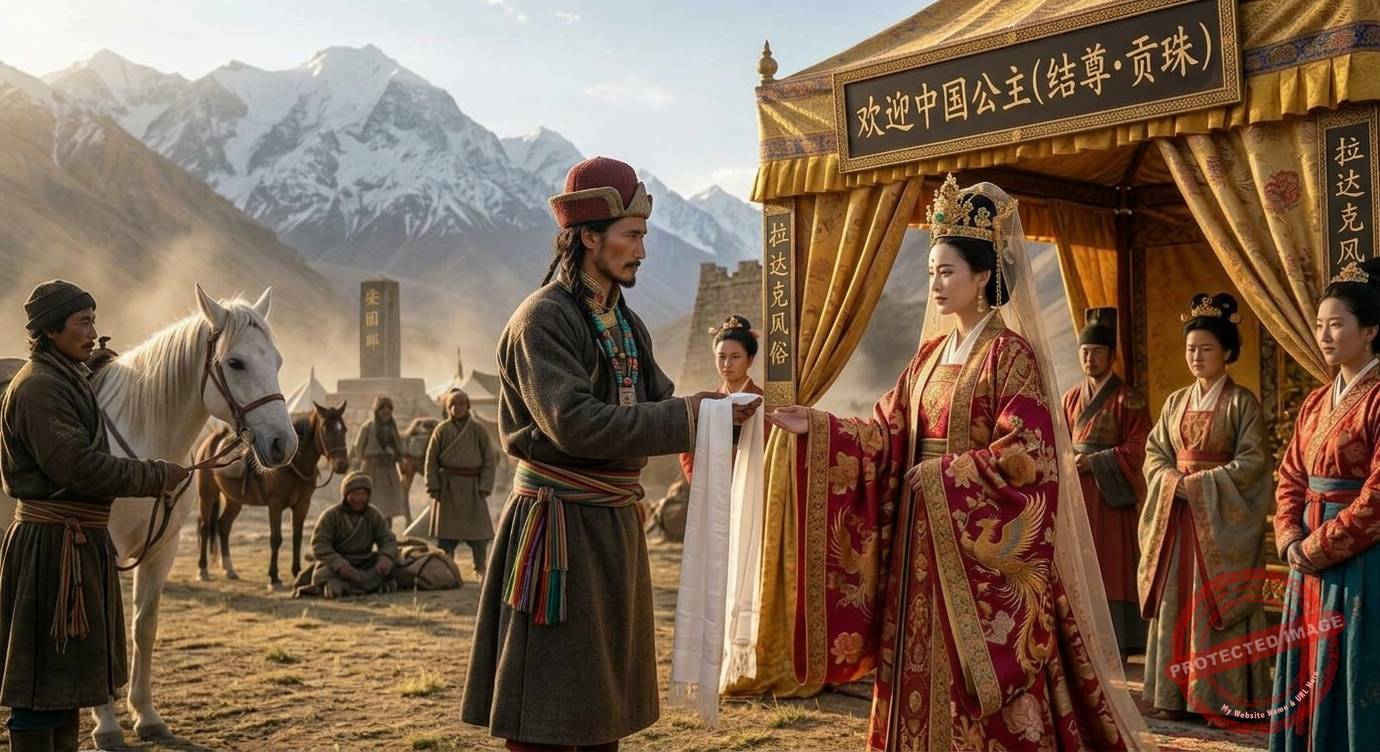
There he encountered gYui dKon mChogmo, whose marriage to Kesar became another important chapter in the hero’s extraordinary life.
The marriage expanded Kesar’s world beyond Ling.
His story was no longer confined to his homeland.
The hero of Ling had entered the world of distant kingdoms.
The Journey Beyond Ling
The previous chapter described Kesar’s extraordinary journey toward China.
After subduing seven kingdoms, Kesar went to a hermitage near the white, black and red hills.
The journey was not straightforward.
He could not find the road to China, and so he remained at the hermitage while preparing to demonstrate his supernatural power.
According to the Lower Ladakhi account recorded by A. H. Francke, Kesar intended to remain there for three years.
The period of waiting was not a sign of weakness.
It was part of his preparation.
Kesar knew that his journey to China would require more than ordinary travel.
He would have to make his presence known across a great distance.
The King of China
Far away, in the kingdom of China, there lived a powerful king.
Kesar’s supernatural presence eventually reached the Chinese court.
The episode is described in the traditional narrative through an extraordinary demonstration.
Kesar was staying at the hermitage, where he had placed the goat Kabulu beneath it.
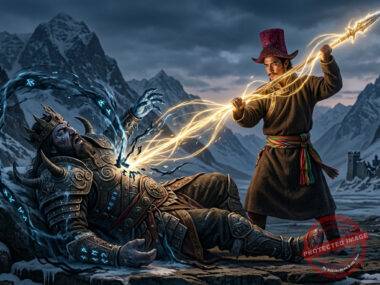
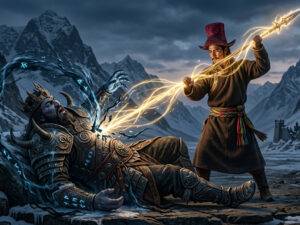
When two and a half years had passed, he demonstrated his magical power toward the distant kingdom.
The effect was immediate.
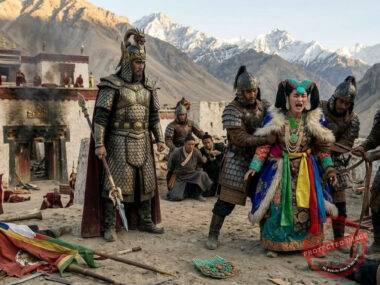
Part of the King’s castle was destroyed, and the King himself began to suffer from pain in his heart.
The strange event could not be understood through ordinary explanations.
The King therefore sought the advice of those who possessed specialised knowledge.
The Diviners and Astrologers
The King of China consulted lot-casters and astrologers.
They recognised that the disturbance was connected with Kesar.
Their conclusion was that Kesar himself had to come.
The King’s condition could not be resolved simply by treating the physical symptoms.
The source of the disturbance lay elsewhere.
Kesar, the distant ruler of Ling, had to be brought into the presence of the Chinese court.
The episode demonstrates an important feature of the Kesar tradition.
The hero’s power does not operate only within his own kingdom.
His supernatural abilities can reach across enormous distances and affect rulers who have never encountered him directly.
The First Messenger
The Chinese were afraid to send an ordinary man to Kesar.
They feared that the messenger might be killed.
Instead, they chose another method.
A bird called iDorre was sent carrying a letter.
The letter invited Kesar to come to China and promised him whatever he might wish to possess.
But Kesar refused.
He would not accept the invitation simply because a bird had carried a written message.
He demanded that the request come through a human messenger.
This response reveals something important about Kesar’s character.
He was not easily summoned.
He understood the significance of his own position and required the Chinese king to approach him properly.
The Man Made from Earth
The King of China then resorted to another extraordinary act.
He cut his own hand and mixed his blood with earth.
From this mixture he formed a man.
The King gave the figure life by breathing into it and sent the newly created messenger to Kesar.
When the messenger reached Kesar, he threw the letter before him.
The strange creature then disappeared.
The episode belongs firmly to the supernatural world of the epic.
The distance between China and Ling is overcome not through ordinary travel but through magical creation.
The King of China creates a messenger from earth and blood, while Kesar himself possesses powers capable of reaching the distant kingdom.
Kesar Waits
Even after receiving the message, Kesar did not immediately leave the hermitage.
His appointed period had not yet been completed.
Instead, he sent Agu Khrai ngo Khrai ’thung.
The messenger was intended to go ahead, but he did not know the road.
A dark fog appeared, and he became delayed on the journey.
Once again, the epic presents travel as something more than movement from one geographical location to another.
The road to China is difficult to find.
The hero must wait.
Messengers become lost.
Fog interrupts the journey.
The distance between Ling and China is therefore transformed into an almost mythical space.
The Completion of Three Years
At last, Kesar’s three years at the hermitage were complete.
He killed the goat Kabulu that had been placed beneath the hermitage.
The flesh was given to birds of prey.
Only after completing this period did Kesar begin the next stage of his journey.
He went to his father bsTanpa and mother sNgonmo.
There he asked them to provide him with extraordinary objects for the journey.
These objects were not ordinary travelling equipment.
They were objects capable of carrying the landscape itself.
The Gifts for the Journey
Kesar requested a basket capable of holding valleys and hills.
He asked for a leather bag capable of holding deserts.
He asked for a pot capable of holding the waters of rivers.
He also requested unusual materials including a bundle of sinews from lice and the blood of red beetles.
These objects belong to the imaginative world of the epic.
The hero is preparing for a journey in which ordinary measurements no longer apply.
Mountains, valleys, deserts and rivers can become things that a supernatural hero can carry.
The landscape itself becomes part of Kesar’s equipment.
Carrying the Landscape
The extraordinary objects Kesar receives can be understood as symbols of the enormous scale of his journey.
The hero is leaving the familiar world of Ling.
He must cross a landscape whose distances are difficult for ordinary human beings to imagine.
The epic therefore transforms geographical obstacles into objects that can be manipulated by supernatural power.
Hills and valleys can be gathered.
Deserts can be contained.
River waters can be carried.
The world becomes something that the hero can move through and, in some sense, carry with him.
This is one of the characteristics that distinguishes epic geography from ordinary geography.
The journey is physical, but it is also mythic.
Entering China
Kesar eventually reaches the distant kingdom associated with China.
His arrival marks an important expansion of the Kesar story.
Until this point, much of the narrative has centred upon Ling and the lands connected with the hero’s early life.
Now the epic opens into a much wider world.
Kesar encounters another royal court.
He enters the sphere of another king.
And within this foreign royal world he encounters gYui dKon mChogmo.
gYui dKon mChogmo
The name gYui dKon mChogmo appears in Francke’s transcription of the Lower Ladakhi material.
The marriage episode is part of the same larger textual section as Kesar’s journey to China.
Francke’s contents specifically identify the section as “Kesar’s journey to China and marriage to gYui dKon mChogmo.”
In the website’s nine-chapter structure, however, the journey and marriage are treated as separate chapters.
This allows the journey itself to be examined as one stage of Kesar’s development, while the marriage can be considered as a separate relationship within the wider epic.
Kesar and the Chinese Royal Household
Kesar’s encounter with gYui dKon mChogmo brings him into another royal household.
The marriage demonstrates how far the hero’s destiny has expanded.
He is no longer simply the young ruler connected with Ling.
His life has become connected with distant kingdoms and foreign courts.
Marriage therefore becomes another means through which the epic expands Kesar’s world.
The hero’s relationships are no longer confined to the people of his homeland.
They extend across the geographical world imagined by the saga.
A Second Marriage
The marriage to gYui dKon mChogmo follows Kesar’s earlier marriage to Duguma (‘aBruguma).
This is important when reading the larger sequence of the saga.
The epic does not present Kesar’s married life as one isolated relationship.
Instead, his marriages become part of a much wider network of families, kingdoms and political relationships.
Duguma remains central to the later story, particularly through her capture by the King of Hor.
The marriage to gYui dKon mChogmo belongs to another stage of Kesar’s journey.
It reflects the expansion of the hero’s world beyond Ling.
Marriage and the Expanding Epic
The marriage to gYui dKon mChogmo also illustrates the geographical imagination of the Kesar tradition.
The hero moves between kingdoms.
He encounters rulers who possess their own courts and supernatural associations.
Marriage connects these different worlds.
The Kesar Saga therefore becomes not merely a story about one kingdom but a vast network of relationships between rulers, families and peoples.
This wider world prepares the ground for the adventures that follow.
The Hero Beyond His Homeland
Kesar’s journey to China changes the scale of the story.
The hero has already demonstrated his extraordinary abilities.
He has subdued kingdoms.
He has remained in a hermitage for three years.
He has communicated his power across a great distance.
He has overcome the obstacles placed before him.
And now he has entered another royal world.
The marriage with gYui dKon mChogmo becomes part of this transformation.
Kesar is increasingly presented as a hero whose destiny extends far beyond the borders of Ling.
The Meaning of the Marriage
The marriage should not be understood solely through the conventions of a modern romantic story.
The Kesar Saga is an epic tradition.
Its marriages are connected with kingship, family, alliances and the movement of the hero between different worlds.
The marriage to gYui dKon mChogmo therefore belongs to the larger pattern of Kesar’s expanding destiny.
It connects the hero with another royal household and another geographical world.
At the same time, the marriage forms part of a sequence that will soon return the story toward the great conflicts associated with the northern giant and, later, Hor.
China in the Kesar Tradition
The China of the Kesar Saga belongs to the geographical and imaginative world of the epic.
It should not automatically be treated as a precise historical description of China or as evidence for a particular historical journey.
The narrative is concerned with heroic geography.
Distant kingdoms can be reached through supernatural means.
Kings can create living messengers from earth and blood.
Mountains, valleys and rivers can be gathered into containers.
These elements belong to the mythic logic of the epic.
For a modern website, it is therefore useful to distinguish the China of the traditional narrative from claims about historical geography or actual historical events.
Versions and Variations
As with other parts of the Kesar Saga, names and details can vary between versions and transcriptions.
The name gYui dKon mChogmo is retained here in the form used in Francke’s Lower Ladakhi material.
Other modern retellings may use different transliterations or spellings.
The same applies to the names of Kesar’s companions, messengers and supernatural beings.
These differences are especially important when comparing a nineteenth- or early twentieth-century transcription with modern English-language writing.
For the website, the historical source spelling should be preserved alongside any reader-friendly form introduced in later editions.
The Oral Epic
The marriage to gYui dKon mChogmo should also be understood within the wider oral character of the Kesar tradition.
Francke’s work is a record of a particular Lower Ladakhi form of the saga rather than a definitive edition of every Kesar story.
His 1909 publication separates the material into distinct episodes, including the journey to China and marriage to gYui dKon mChogmo, followed by the victory over the giant of the North.
This sequence provides an important historical framework for the website series.
At the same time, the existence of other regional traditions means that individual episodes may appear differently elsewhere.
Cultural Context
Marriage in heroic epics often carries significance beyond the private lives of the people involved.
A ruler’s marriage can connect families, kingdoms and political worlds.
In the Kesar tradition, this becomes particularly important because Kesar repeatedly crosses the boundaries between different kingdoms.
His marriages form part of that wider movement.
The marriage to Duguma connects him with Ling.
The marriage to gYui dKon mChogmo belongs to his encounter with the distant Chinese royal world.
The epic therefore presents Kesar’s personal life alongside his expanding political and geographical destiny.
A Wider World
The story has now travelled far from the humble beginnings described in the birth narrative.
The child born through supernatural signs has become a ruler.
The ruler has subdued kingdoms.
He has travelled beyond Ling.
He has communicated with a distant king through supernatural power.
He has entered another royal household.
And he has married gYui dKon mChogmo.
The scale of the Kesar Saga continues to grow.
What began as the story of a miraculous child is becoming the story of a hero whose movements connect distant lands.
Source Notes
Primary source
A. H. Francke, A Lower Ladakhi Version of the Kesar-Saga, Calcutta, 1909.
Francke’s contents place the Tibetan text of Kesar’s journey to China and marriage to gYui dKon mChogmo on pages 139–153, followed by the abstract of contents, vocabulary and comments on pages 154–163.
The abstract records Kesar’s stay at the hermitage, his supernatural communication with the King of China, the Chinese king’s creation of a messenger from earth and blood, Kesar’s completion of the three-year period, and his preparation for the journey.
The following episode in Francke’s sequence is Kesar’s victory over the giant of the North, which occupies the next section of the publication.
Editorial note
This page is a website-oriented English narrative adaptation based principally on the Lower Ladakhi material recorded by Francke.
The marriage to gYui dKon mChogmo is presented here as a separate chapter because of the established nine-chapter structure of this website series, although Francke’s original contents combine Kesar’s journey to China and the marriage in a single section.
Names and spellings follow Francke where appropriate, while explanatory prose is written in modern English for readability.
The supernatural geography and events described here belong to the epic tradition and should not be presented as straightforward historical documentation.
What Comes Next
Kesar’s journey has taken him beyond Ling and into the distant royal world of China.
His marriage to gYui dKon mChogmo marks another stage in the expansion of his destiny.
But the journey does not end with marriage.
The next episode brings Kesar face to face with another extraordinary adversary: the giant of the North.
The story now moves from the distant royal world of China to a new heroic confrontation, where Kesar’s strength and supernatural abilities will once again be tested.
Chapter Navigation
Previous Chapter:
Ling Kesar — Kesar’s Journey to China
Next Chapter:
Ling Kesar — The Northern Giant