 Writer
Region: Ladakh, particularly the Lower Ladakhi tradition
Tradition: Kesar / Gesar epic
Story type: Epic / heroic legend / war and victory tale
Main figure(s): Kesar of Ling, ‘aBruguma (Duguma), the King of Hor
Previous chapter: The Capture of ‘aBruguma by the King of Hor
Next chapter: End of the Kesar Saga Chapters
Kesar Saga Chapters
- The Prologue to the Kesar Saga
- The Birth of Kesar
- Kesar’s Childhood and the Making of the Hero
- The Story of ‘aBruguma’s Marriage to Kesar
- Kesar’s Journey to China
- Kesar’s Marriage to gYui dKon mChogmo
- The Northern Giant
- The Capture of ‘aBruguma by the King of Hor
- The Defeat of the King of Hor
This sequence forms the principal structural basis for this website series.
Short Excerpt
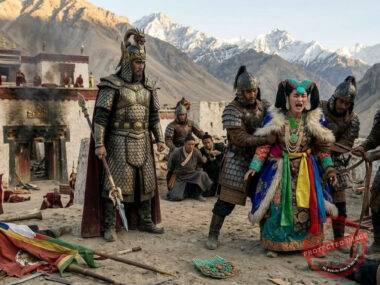
The King of Hor had invaded Ling.
‘aBruguma had been taken away.
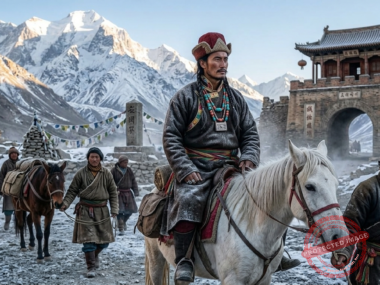
Kesar, having learned of her capture, entered the land of his enemy in disguise.
He became a smith.
He learned the craft.
He prepared an iron rope with the assistance of the smith and found a way to reach the castle of Hor.
Now the long conflict between Ling and Hor was approaching its final encounter.
Kesar had faced supernatural beings, distant kings and impossible journeys.
But the struggle with Hor was different.
It was a conflict between rulers.
And at its centre was the woman whose capture had brought Kesar back into the story.
The final confrontation would take place between Kesar and the King of Hor.
The Return of Kesar
Kesar had been away from Ling when the King of Hor attacked.
The news of ‘aBruguma’s capture reached him through messengers, and he began the journey toward Hor.
The hero who had travelled through distant kingdoms now had a single purpose.
He had to recover his wife.
But Kesar did not approach the enemy as an ordinary king.
He entered the land of Hor in disguise.
The great ruler of Ling became a humble craftsman.
His royal identity remained hidden.
Kesar the Smith
In the land of Hor, Kesar took service with a smith.
He learned the craft of metalworking and became familiar with the tools and skills of the workshop.
This part of the story is important because the epic temporarily removes Kesar from his royal position.
He does not arrive wearing the signs of kingship.
He works with his hands.
He observes.
He learns.
And he waits.
The disguise gives Kesar access to a world that would otherwise be closed to him.
The Hidden Preparation
Kesar’s time with the smith is also a period of preparation.
He is not simply hiding from the King of Hor.
He is preparing for the attempt to reach the castle.
The smith becomes part of his plan.
Together they prepare an iron rope.
The object will allow Kesar to overcome the physical barriers protecting the King’s stronghold.
The story once again shows that Kesar’s heroism depends upon more than physical strength.
He must understand his surroundings and use whatever knowledge is available to him.
The Castle of Hor
The castle of Hor is the centre of the enemy’s power.
It is not easily approached.
Kesar therefore cannot simply walk through its gates.
Instead, he uses the iron rope to reach the castle.
The ascent is another example of the unusual methods through which the hero accomplishes his goals.
The man who entered Hor as a smith is now moving toward the King’s own stronghold.
The disguise has served its purpose.
Reaching the King
Kesar eventually reaches the castle.
The distance between the two rulers has narrowed.
The King of Hor has taken ‘aBruguma.
He has attacked Ling.
He has brought the conflict into Kesar’s household.
Now Kesar has reached the place from which the King exercises his power.
The final encounter is no longer distant.
Kesar and the King of Hor
The meeting between Kesar and the King of Hor becomes a direct contest.
The King is not defeated by a distant army.
Kesar confronts him personally.
The struggle becomes a test of strength between the two rulers.
This is the culmination of the conflict that began with the capture of ‘aBruguma.
The King of Hor has challenged the household and kingdom of Ling.
Kesar now answers that challenge himself.
The Wrestling Contest
The decisive encounter takes the form of a wrestling contest.
The contest strips away the usual symbols of kingship.
There are no distant armies deciding the result.
There is no battlefield in which one ruler can remain safely behind his soldiers.
The two men confront one another directly.
Kesar’s extraordinary strength is tested against the power of the King of Hor.
The contest becomes the physical expression of the larger struggle between Ling and Hor.
The Defeat of Hor
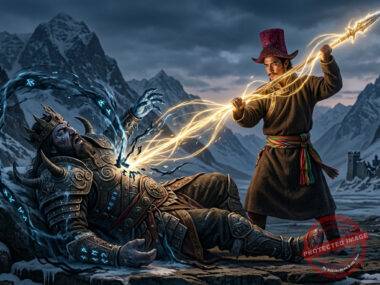
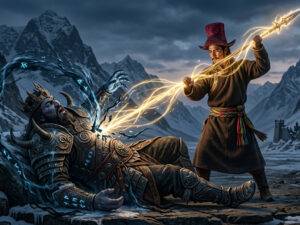
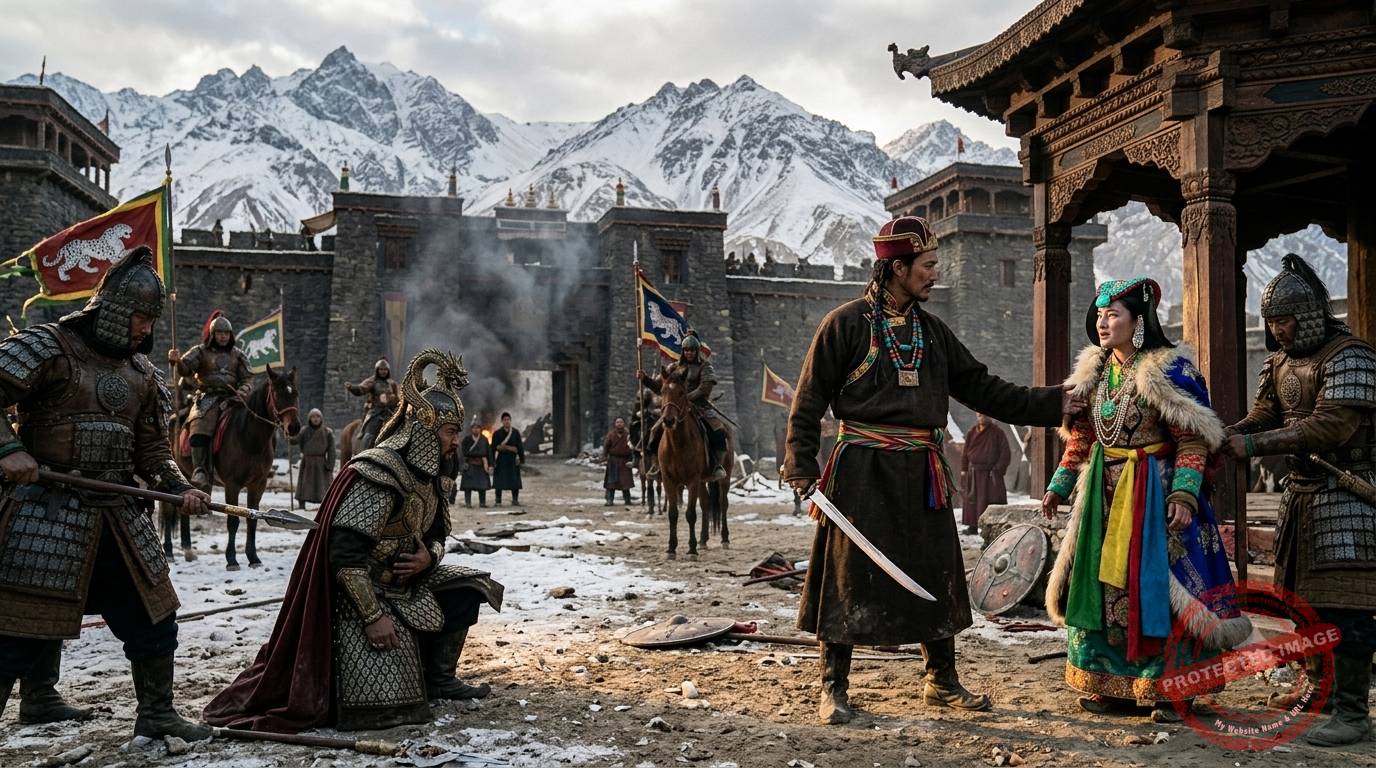
Kesar defeats the King of Hor.
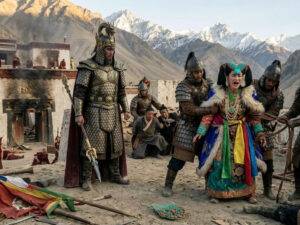
The enemy ruler who had invaded Ling and captured ‘aBruguma is finally overcome.
Francke’s summary of the Lower Ladakhi tradition describes Kesar as ascending the castle of Hor with the help of an iron rope and killing the King in a wrestling contest.
The conflict that began with the invasion of Ling has reached its decisive conclusion.
Hor has lost its king.
Kesar has accomplished the purpose for which he entered the enemy’s land.
The End of the King
The death of the King of Hor marks the end of his threat to Ling.
The ruler who had appeared as a powerful enemy has been defeated by the hero himself.
The victory is personal, but its consequences are much wider.
The political danger facing Ling has been removed.
The captivity of ‘aBruguma can now come to an end.
Kesar’s long journey toward Hor has reached its purpose.
‘aBruguma Is Recovered
With the defeat of the King of Hor, ‘aBruguma is no longer held by the enemy.
She can return to Kesar.
The relationship that had been broken by the invasion can now be restored.
This gives the Hor episode a different ending from many of the earlier adventures in Kesar’s life.
The hero does not simply defeat an enemy and move on.
He returns with the person whose capture caused the conflict.
‘aBruguma’s Part in the Story
Francke’s summary adds an important detail concerning ‘aBruguma.
He states that she was “not quite without fault” in the affair and that she was punished before she and Kesar returned to live together at the castle of Ling.
This detail belongs to Francke’s recorded version and should be distinguished from modern interpretations.
The website should not turn this element into a moral judgement about the character herself.
Instead, it should be understood as part of the particular Lower Ladakhi narrative recorded by Francke.
The Return to Ling
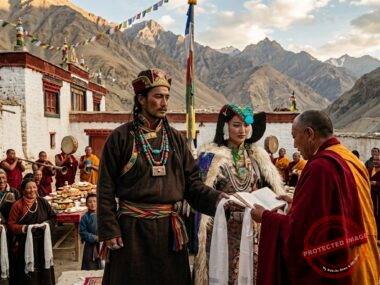
After the defeat of Hor, Kesar and ‘aBruguma return to Ling.
The castle that had once been threatened by the enemy becomes their home again.
The story returns to the place where much of Kesar’s destiny had begun.
Ling has survived.
Its king has returned.
Its queen has returned.
And the great enemy who had disrupted the kingdom has been defeated.
The long movement of the Hor story has therefore come full circle.
The Hero’s Many Faces
The Hor episode brings together several qualities that have appeared throughout Kesar’s story.
Kesar can be a king.
He can become a traveller.
He can become a supernatural warrior.
He can become a craftsman.
He can disguise himself.
He can use knowledge and strategy.
And when the final moment arrives, he can fight directly.
The hero is therefore not defined by one ability alone.
His strength is combined with adaptability.
The Smith and the King
The contrast between the smith’s workshop and the King’s castle is especially striking.
Kesar begins the episode as a worker among ordinary people.
He learns a practical craft.
From there, he prepares the means by which he reaches the royal stronghold.
The journey from the workshop to the castle mirrors the larger transformation of the hero.
Kesar can move between the lowest and highest levels of society without losing his identity.
The king can become a smith.
The smith can reveal himself as a king.
The Iron Rope as a Heroic Device
The iron rope is one of the memorable objects associated with the Hor episode.
Its importance is practical within the story.
The castle is difficult to approach, and the rope provides a way for Kesar to overcome the obstacle.
But it also illustrates the epic’s wider pattern.
Again and again, Kesar confronts a barrier that appears impossible to ordinary people.
He then finds a way around it.
The hero does not always defeat an obstacle by force.
Sometimes he defeats it by understanding how it can be overcome.
The Conflict Between Ling and Hor
The conflict has now moved through several stages.
First, Hor attacks Ling.
Then ‘aBruguma is captured.
News reaches Kesar.
Kesar enters Hor in disguise.
He becomes a smith.
He prepares the iron rope.
He reaches the castle.
He confronts the King.
And finally, the King of Hor is defeated.
The sequence gives the final part of the saga a clear dramatic movement from invasion to recovery.
The Meaning of Victory
Within the epic tradition, Kesar’s victory restores the balance between the two kingdoms.
The enemy has been defeated.
The queen has been recovered.
The king has returned.
Ling once again becomes the centre of Kesar’s world.
The victory therefore represents more than the defeat of an individual opponent.
It restores the household and political order associated with the hero.
Kesar’s Return to Peace
After the long series of adventures, Kesar and ‘aBruguma return to live together at the castle of Ling.
Francke’s historical summary describes the conclusion in these terms: after Hor is defeated and ‘aBruguma’s part in the affair is dealt with, the two return to the Ling castle and live together.
The epic has reached a moment of restoration.
The hero has travelled far.
He has faced supernatural beings.
He has entered foreign kingdoms.
He has married in distant lands.
He has fought giants.
He has lost and recovered his wife.
And now he returns home.
The End of This Saga Sequence
This chapter brings the nine-part website sequence to its conclusion.
The story began with the origins of Ling and the miraculous birth of Kesar.
It continued through his childhood, marriage to ‘aBruguma, journey to China, marriage to gYui dKon mChogmo and encounter with the Northern Giant.
Then came the invasion of Ling and the capture of ‘aBruguma.
The final movement brought Kesar into the land of Hor.
There he entered the enemy’s world in disguise, prepared his iron rope, reached the castle and defeated the King.
The story has therefore travelled from birth to kingship, from home to distant lands, and from separation back to reunion.
The Nine-Chapter Journey
The nine chapters of this website series form a continuous narrative:
- The Prologue to the Kesar Saga establishes the world and origins surrounding Ling.
- The Birth of Kesar introduces the extraordinary circumstances of the hero’s arrival.
- Kesar’s Childhood and the Making of the Hero follows the development of the extraordinary child.
- The Story of ‘aBruguma’s Marriage to Kesar introduces one of the central relationships of the epic.
- Kesar’s Journey to China takes the hero beyond the familiar world of Ling.
- Kesar’s Marriage to gYui dKon mChogmo expands the hero’s relationships into another royal world.
- The Northern Giant brings Kesar into confrontation with a supernatural adversary.
- The Capture of ‘aBruguma by the King of Hor transforms the story through invasion, captivity and separation.
- The Defeat of the King of Hor brings the conflict to its conclusion.
This sequence follows the structure established for the website while recognising that Francke’s original publication organised the material into seven major tales. His preface lists the sequence from the prologue through Kesar’s defeat of Hor, while the 1909 contents separately identify the corresponding textual sections.
Cultural Context
The defeat of the King of Hor occupies a particularly important place in the Lower Ladakhi Kesar tradition.
Modern scholarship has noted that Francke divided the Lower Ladakhi narrative into seven major sections, ending with Kesar’s victory over the King of Hor. Siddiq Wahid describes these as major watershed experiences in Kesar’s life, while emphasising that the epic is an oral narrative preserved through particular storytellers and local traditions.
The final Hor episode therefore should not be treated simply as the ending of a conventional historical biography.
It belongs to an oral heroic tradition in which supernatural abilities, disguises, extraordinary journeys and symbolic conflicts are woven into the life of the hero.
The Oral Nature of the Epic
The Kesar tradition does not exist as one single fixed story.
Francke himself observed that the saga was told differently in different villages and argued that a fuller understanding required collecting versions from across Ladakh.
This is particularly important when discussing the ending.
Different tellings may give different emphasis to:
- the capture of ‘aBruguma
- Kesar’s disguise
- the role of the smith
- the journey into Hor
- the confrontation with the King
- the fate of ‘aBruguma
- the return to Ling
The Lower Ladakhi version recorded by Francke provides one important historical record of the story.
It should not be treated as the only possible form of the Kesar epic.
Versions and Variations
The names in this episode can also appear in different forms.
Kesar may appear as Gesar, Gesar of Ling, Ling Kesar or Ling Norbu Dadul.
‘aBruguma may appear as Duguma, Dugmo or Drukmo.
The King of Hor is associated with different names and descriptions in different sources.
These variations are characteristic of a tradition transmitted across languages, regions and generations.
For the Ladakh Folklore Library, the source form ‘aBruguma is retained where it corresponds to Francke’s Lower Ladakhi transcription.
Source Notes
Primary source
A. H. Francke, A Lower Ladakhi Version of the Kesar-Saga, Calcutta, 1909.
Francke’s publication places “Defeat of the king of Hor” on pages 256–305, followed by “Tale No. VII. Defeat of the king of Hor — abstract of contents, vocabulary” on pages 306–321.
The publication’s preface gives the overall Lower Ladakhi sequence as:
Prologue → Birth of Kesar → Wooing and marriage to ‘aBruguma → Journey to China and marriage to a Chinese princess → Journey to the North → Capture of ‘aBruguma by the King of Hor → Kesar’s defeat of the King of Hor.
Historical summary
Francke’s A History of Western Tibet provides a concise English summary of this final sequence. It describes Kesar entering Hor after learning of ‘aBruguma’s capture, taking service with a smith, learning the trade, using an iron rope to reach the castle, defeating the King in a wrestling contest, and returning to Ling with ‘aBruguma.
Oral tradition
Later scholarship continues to emphasise that this Lower Ladakhi narrative represents one particular telling of a much wider Kesar tradition. Siddiq Wahid describes Francke’s version as one oral narrative from Ladakh and stresses the importance of the storyteller and local context in understanding the epic.
Editorial note
This page is a website-oriented English narrative adaptation based principally on the Lower Ladakhi material recorded by A. H. Francke.
The nine-chapter structure used by this website expands Francke’s seven major sections by treating some of the larger episodes—particularly the China journey and marriage—as separate chapters.
The events described here belong to the Kesar epic and oral tradition. They should therefore be presented as folklore and heroic narrative rather than as straightforward historical documentation.
Where a detail comes specifically from Francke’s historical summary or interpretation, it should remain distinguishable from the underlying oral tradition.
What Comes Next
The defeat of the King of Hor brings the principal nine-chapter sequence of the Ladakh Folklore Library’s Kesar Saga to its conclusion.
Kesar has travelled from his miraculous birth to the heights of kingship.
He has crossed distant lands.
He has entered foreign kingdoms.
He has faced supernatural beings.
He has married.
He has experienced separation.
He has lost and recovered his wife.
And finally, he has defeated the King of Hor and returned to Ling.
But the Kesar tradition is far larger than this single sequence.
The nine chapters presented here form one important Lower Ladakhi narrative framework. Beyond them lies a much wider world of Kesar songs, oral performances, local place traditions, variant episodes, genealogies, supernatural beings, battles, journeys and regional tellings.
The story therefore does not truly end here.
This is the end of one narrative cycle—and the beginning of a larger exploration of the Kesar tradition preserved across Ladakh and the wider Himalayan world.
Chapter Navigation
Previous Chapter:
Ling Kesar — The Capture of ‘aBruguma by the King of Hor
Current Chapter:
Ling Kesar — The Defeat of the King of Hor
Kesar Saga Sequence Complete