 Writer
Ling Kesar — The Northern Giant
Region: Ladakh, particularly the Lower Ladakhi tradition
Tradition: Kesar / Gesar epic
Story type: Epic / heroic legend / supernatural adventure
Main figure: Kesar of Ling
Previous chapter: Kesar’s Marriage to gYui dKon mChogmo
Next chapter: The Capture of ‘aBruguma by the King of Hor
Kesar Saga Chapters
- The Prologue to the Kesar Saga
- The Birth of Kesar
- Kesar’s Childhood and the Making of the Hero
- The Story of ‘aBruguma’s Marriage to Kesar
- Kesar’s Journey to China
- Kesar’s Marriage to gYui dKon mChogmo
- The Northern Giant
- The Capture of ‘aBruguma by the King of Hor
- The Defeat of the King of Hor
This sequence forms the principal structural basis for this website series.
Short Excerpt
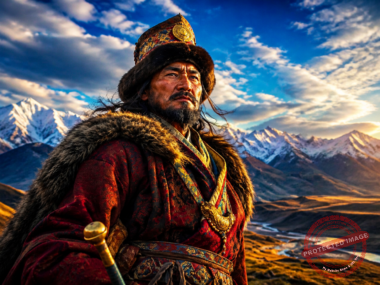
Kesar had travelled far beyond Ling.
He had crossed into the distant world associated with China, encountered another royal household, and married gYui dKon mChogmo.
But his adventures were not finished.
The next challenge awaited him in the north.
There lived a powerful giant, a supernatural being whose strength and presence posed another test for the hero of Ling.
Kesar travelled north to confront him.
Yet the journey would not be a simple battle.
Before Kesar could defeat the giant, he would have to enter the giant’s own world, encounter his household, and survive a dangerous meeting with a being whose power was greater than that of ordinary men.
The story of the Northern Giant is therefore another demonstration of Kesar’s ability to overcome danger not only through strength, but also through patience, intelligence and extraordinary courage.
Kesar Turns Toward the North
After his journey to China and his marriage to gYui dKon mChogmo, Kesar’s adventures continued.
The next great challenge took him toward the north.
In Francke’s Lower Ladakhi sequence, this episode is presented as Kesar’s victory over the giant of the North. The section follows directly after the China episode and forms one of the major adventures of the hero’s life.
The northern journey carries Kesar into another part of the supernatural geography of the epic.
The world beyond Ling is filled with powerful beings.
Not every threat can be confronted by ordinary armies.
Some enemies must be approached through cunning, courage and personal skill.
The giant of the North represents precisely this kind of challenge.
The Giant of the North
The giant is a supernatural adversary.
He is not simply another rival king.
His power belongs to the extraordinary world that surrounds Kesar throughout the epic.
The encounter therefore continues one of the central patterns established in the earlier chapters.
Kesar repeatedly enters worlds inhabited by beings whose strength and abilities exceed those of ordinary human beings.
The hero’s greatness is demonstrated by his ability to confront them.
The northern giant becomes another test of that extraordinary destiny.
The Journey Into the North
Kesar travels toward the giant’s territory.
The journey itself forms part of the challenge.
The northern country is distant from the familiar world of Ling.
As in the journey to China, geographical distance in the Kesar Saga is also mythic distance.
The hero is entering a world where supernatural beings possess their own castles, households and territories.
The further Kesar travels, the further he moves from the ordinary human world.
Bruguma Wants to Follow
In the Lower Ladakhi account, ‘aBruguma, Kesar’s first wife, wishes to accompany him on the northern expedition.
Her desire to follow Kesar reflects the close connection between the hero and his household.
But Kesar does not allow her to continue with him.
She is sent back.
The decision separates Kesar from Duguma before he reaches the giant’s territory.
This detail becomes significant when the larger sequence of the epic is considered.
Kesar’s northern adventure takes place while his household remains behind.
Soon afterward, the story will move toward the capture of ‘aBruguma by the King of Hor.
The northern episode therefore stands immediately before one of the greatest changes in Kesar’s life.
The Giant’s Castle
After overcoming the difficulties of the journey, Kesar eventually reaches the territory of the giant.
But when he arrives, the giant is not there.
Kesar has reached the enemy’s home without finding the enemy himself.
This creates a very different kind of danger.
A straightforward warrior might wait for the opponent and fight when he returns.
Kesar must instead enter an unfamiliar household and decide how to survive until the giant comes back.
The epic therefore turns the expected battle into a story of concealment, patience and intelligence.
The Giant’s Wife
The giant’s wife encounters Kesar.
Instead of immediately attacking him, she takes him into her household.
This becomes one of the most unusual episodes in the northern adventure.
Kesar has entered the home of his enemy, but he is not immediately treated as an enemy.
The giant’s wife becomes an important figure in the episode because her actions create the opportunity for Kesar to survive.
The hero is now dependent not only on his own strength but also on the decisions of someone who belongs to the giant’s household.
Waiting for the Giant
The giant is expected to return.
Kesar knows that the encounter will be dangerous.
The situation therefore becomes a test of patience.
The hero must remain hidden and wait.
He cannot simply challenge the giant openly.
The danger is too great.
The story presents another side of Kesar’s heroic character.
His strength is important, but his ability to recognise danger and wait for the right moment is equally important.
The Earthquake
The giant’s approach is announced by a tremendous disturbance.
The earth shakes.
The arrival of the giant is therefore not presented as an ordinary human arrival.
His presence affects the landscape itself.
The earthquake becomes a sign that the supernatural enemy is approaching.
Kesar now knows that the moment of confrontation is near.
Kesar Is Hidden
The giant’s wife hides Kesar beneath the ground.
He is concealed in a hole underneath the earth.
The hiding place protects him from the giant’s immediate discovery.
But the concealment is not perfect.
The giant possesses extraordinary senses.
He can smell the presence of a human being.
The danger is therefore extremely close.
Kesar has entered the giant’s home and is hiding beneath the ground while the giant is already aware that something unusual is present.
The Giant Smells a Human Being
The giant immediately senses that there is a human presence.
This moment demonstrates the difference between the giant and an ordinary opponent.
Kesar cannot rely upon simple concealment.
The giant’s supernatural abilities make him capable of detecting what an ordinary person could not.
The situation becomes increasingly dangerous.
The giant’s wife must now find a way to calm him.
The Giant Is Pacified
The giant’s wife manages to calm him.
Through her influence, the giant is persuaded to accept the situation and eventually to go to sleep.
This creates the opportunity Kesar has been waiting for.
The great confrontation will not begin with a public challenge.
Instead, Kesar will act when the giant is asleep.
The episode therefore emphasises the hero’s ability to recognise the right moment.
The Giant Falls Asleep
Once the giant is asleep, Kesar is brought out from his hiding place.
The danger has not disappeared.
The giant remains enormously powerful.
But the balance has changed.
The hero now has the opportunity to act before the giant can use his strength against him.
The northern adventure reaches its decisive moment.
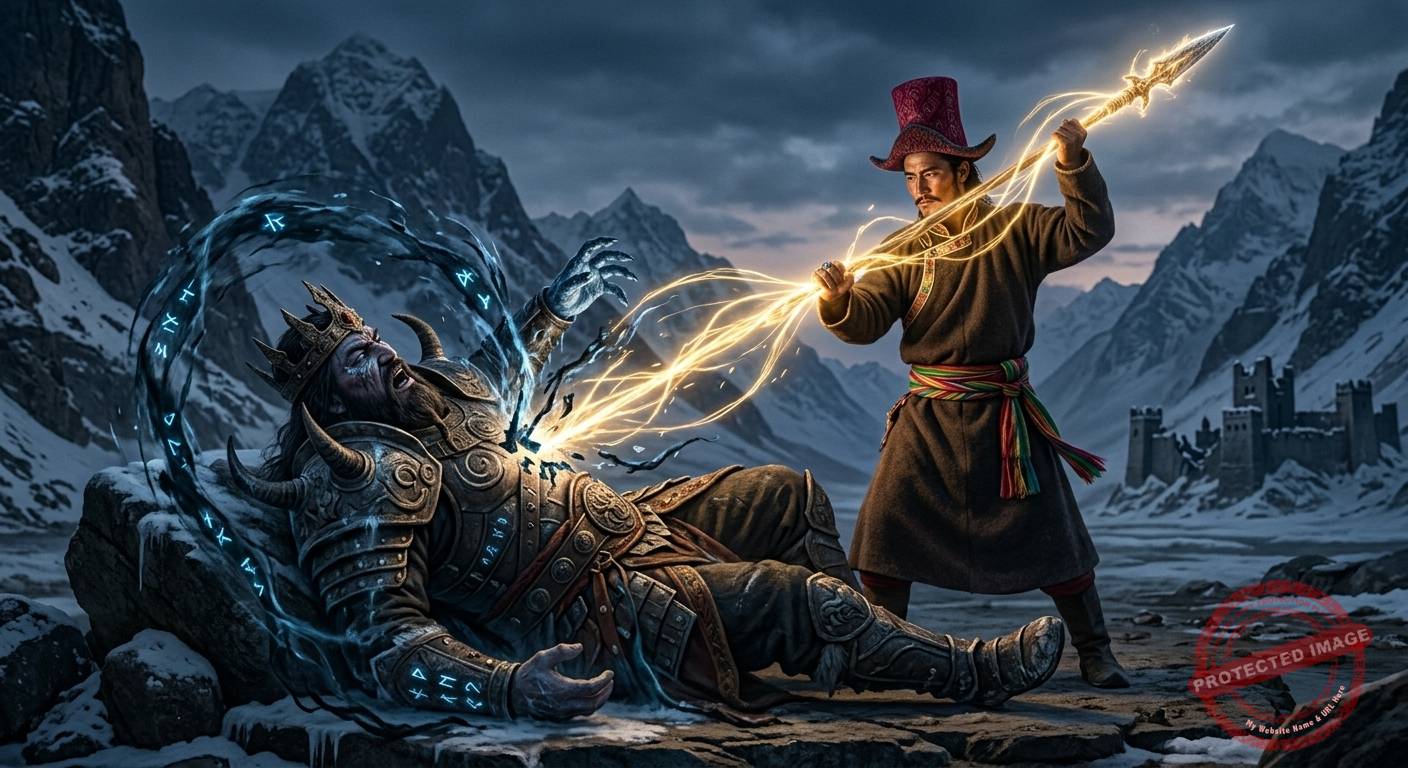
Kesar Attacks
Kesar confronts the giant while he is asleep.
The hero’s victory comes through a combination of courage, timing and supernatural ability.
The story does not portray the encounter as an ordinary military battle.
There is no great army surrounding the giant’s castle.
There is no battlefield filled with soldiers.
The confrontation is personal.
Kesar faces the supernatural enemy himself.
The Defeat of the Giant
Kesar succeeds in killing the giant.
The great northern adversary is defeated.
The episode becomes another demonstration of the hero’s ability to overcome supernatural beings who appear far more powerful than ordinary men.
The victory also continues a recurring pattern in the Kesar Saga.
Again and again, Kesar enters the territory of a powerful enemy and turns a seemingly impossible situation in his favour.
The giant possesses extraordinary strength.
But Kesar possesses something equally important: the ability to combine courage with intelligence.
More Than a Battle
The story of the Northern Giant is therefore more than a tale of physical combat.
Kesar does not defeat the giant by simply proving that he is stronger.
He survives because he understands the situation.
He accepts the need for concealment.
He waits.
He allows the giant’s household to create an opportunity.
And when the right moment arrives, he acts decisively.
The episode adds another dimension to the portrait of Kesar.
The hero is a warrior, but he is also a strategist.
The Supernatural Hero
The northern adventure continues the epic’s portrayal of Kesar as a figure who moves between the human and supernatural worlds.
He can confront giants.
He can enter their castles.
He can survive dangers that would overwhelm ordinary people.
The supernatural is therefore not something Kesar simply observes.
It is the environment in which his heroic abilities are repeatedly tested.
His victory over the northern giant strengthens his position as a hero capable of confronting beings beyond the ordinary human world.
The Meaning of the North
The north in the Kesar tradition is more than a direction on a map.
It can be associated with supernatural beings, distant territories and powerful enemies.
Earlier Kesar material already connected the north with supernatural forces.
Francke’s earlier writings on Kesar traditions also discuss a northern castle associated with a powerful supernatural being. His documentation shows that the geography of the epic should be understood within the mythological world of the tradition rather than treated simply as a modern geographical map.
The northern journey therefore represents another movement into the unknown.
Duguma and the Separation
One of the important features of this episode is the separation between Kesar and Duguma.
She wishes to accompany him.
He sends her back.
For the moment, this may appear to be a minor detail.
But in the wider sequence it becomes significant.
Kesar’s northern adventure is followed by the capture of ‘aBruguma by the King of Hor.
The hero’s household will soon face a crisis that changes the direction of the entire saga.
The northern journey therefore stands at the threshold between two major stages of Kesar’s life.
From the Giant to Hor
The sequence recorded by Francke is remarkably clear.
The story of Kesar’s victory over the giant of the North is followed by the capture of ‘aBruguma by the King of Hor, and that is followed by the defeat of the King of Hor.
This sequence gives the northern adventure a special position in the overall structure.
Kesar has just demonstrated his ability to defeat a supernatural enemy.
But an entirely different danger is approaching.
The next enemy will not initially come against Kesar himself.
Instead, the threat will fall upon his kingdom and his wife.
A Different Kind of Conflict
The northern giant represents supernatural physical power.
The King of Hor represents something different.
He is a rival ruler whose actions will affect the political world of Ling.
This changes the nature of the story.
Kesar has already shown that he can defeat monsters and supernatural beings.
Now he must respond to an enemy who attacks the kingdom and takes away someone close to him.
The saga is moving from supernatural adventure toward political and personal conflict.
The Hero After Victory
Kesar has defeated the giant.
He has survived another extraordinary test.
But victory does not bring permanent peace.
The Kesar Saga repeatedly places the hero immediately before another challenge.
One enemy falls.
Another appears.
One journey ends.
Another begins.
This rhythm is central to the epic structure.
The hero’s life is a continuous movement through danger, separation, struggle and return.
Cultural Context
The Northern Giant belongs to the supernatural side of the Kesar tradition.
Giants, ogres, demons and other extraordinary beings appear throughout Kesar narratives, creating a world in which heroic action takes place alongside mythic forces.
The episode also demonstrates an important characteristic of oral epic storytelling.
A conflict that might ordinarily be represented as a military battle can instead become a personal encounter between a hero and a supernatural opponent.
Kesar’s victory is therefore achieved through individual courage and intelligence rather than through a conventional army.
This helps distinguish the heroic adventures of the Kesar Saga from a straightforward historical chronicle.
Versions and Variations
The Kesar tradition exists in numerous oral and regional forms.
The Lower Ladakhi version recorded by Francke is one particular form of the larger epic.
Modern scholarship continues to emphasise the importance of recognising Kesar as an oral tradition rather than assuming that one written text represents every version.
Siddiq Wahid, discussing the Lower Ladakhi tradition, describes Francke’s version as a sequence of major episodes that includes Kesar’s journey to China, his victory over the giant of the north, the kidnapping of Duguma by the Hor King and Kesar’s eventual victory over Hor.
Accordingly, details of the giant, his household, Kesar’s journey and the circumstances of the confrontation may differ in other tellings.
The version presented here follows the Lower Ladakhi framework.
Source Notes
Primary source
A. H. Francke, A Lower Ladakhi Version of the Kesar-Saga, Calcutta, 1909.
Francke’s publication places “Kesar’s victory over the giant of the North” on pages 164–188, followed by its abstract, vocabulary and comments on pages 189–199.
The same publication places the subsequent story, “Capture of ‘aBruguma by the King of Hor,” on pages 200–242.
Wider documentation
Francke’s earlier writings on the Kesar tradition also emphasise that the saga was told differently in different villages and that the oral material contained variations between versions.
A modern scholarly discussion by Siddiq Wahid likewise treats Francke’s Lower Ladakhi version as one particular oral narrative tradition rather than as a universally fixed form of the epic.
Editorial note
This page is a website-oriented English narrative adaptation based principally on the Lower Ladakhi tradition recorded by Francke.
The episode has been kept separate as Chapter 7 because this website follows the established nine-chapter structure.
The supernatural beings, events and geography belong to the epic tradition and should be understood as folklore rather than presented as straightforward historical documentation.
Where the traditional material varies between versions, the variation should be preserved rather than silently combined.
What Comes Next
Kesar has defeated the giant of the North.
But while the hero has been away facing supernatural danger, the world of Ling is moving toward another crisis.
The next chapter returns the story to ‘aBruguma, Kesar’s first wife.
The King of Hor will enter the story, and ‘aBruguma will be taken away from Ling.
This changes the direction of the saga.
The northern adventure was a test of Kesar against a supernatural giant.
The next chapter will become a story of loss, captivity and the beginning of Kesar’s confrontation with Hor.
The saga now moves from the defeat of the Northern Giant to the capture of ‘aBruguma by the King of Hor.
Chapter Navigation
Previous Chapter:
Ling Kesar — Kesar’s Marriage to gYui dKon mChogmo
Next Chapter:
Ling Kesar — The Capture of ‘aBruguma by the King of Hor