 Writer
Region: Ladakh, particularly the Lower Ladakhi tradition
Tradition: Kesar / Gesar epic
Story type: Epic / heroic legend
Main figure: Kesar of Ling
Previous chapter: The Birth of Kesar
Next chapter: Kesar and Duguma
Kesar Saga Chapters
- The Prologue to the Kesar Saga
- The Birth of Kesar
- Kesar’s Childhood and the Making of the Hero
- The Story of ‘aBruguma’s Marriage to Kesar
- Kesar’s Journey to China
- Kesar’s Marriage to gYui dKon mChogmo
- The Northern Giant
- The Capture of ‘aBruguma by the King of Hor
- The Defeat of the King of Hor
This sequence forms the principal structural basis for this website series.
Short Excerpt
Kesar’s birth marks the beginning of his extraordinary destiny, but birth alone does not make a hero.
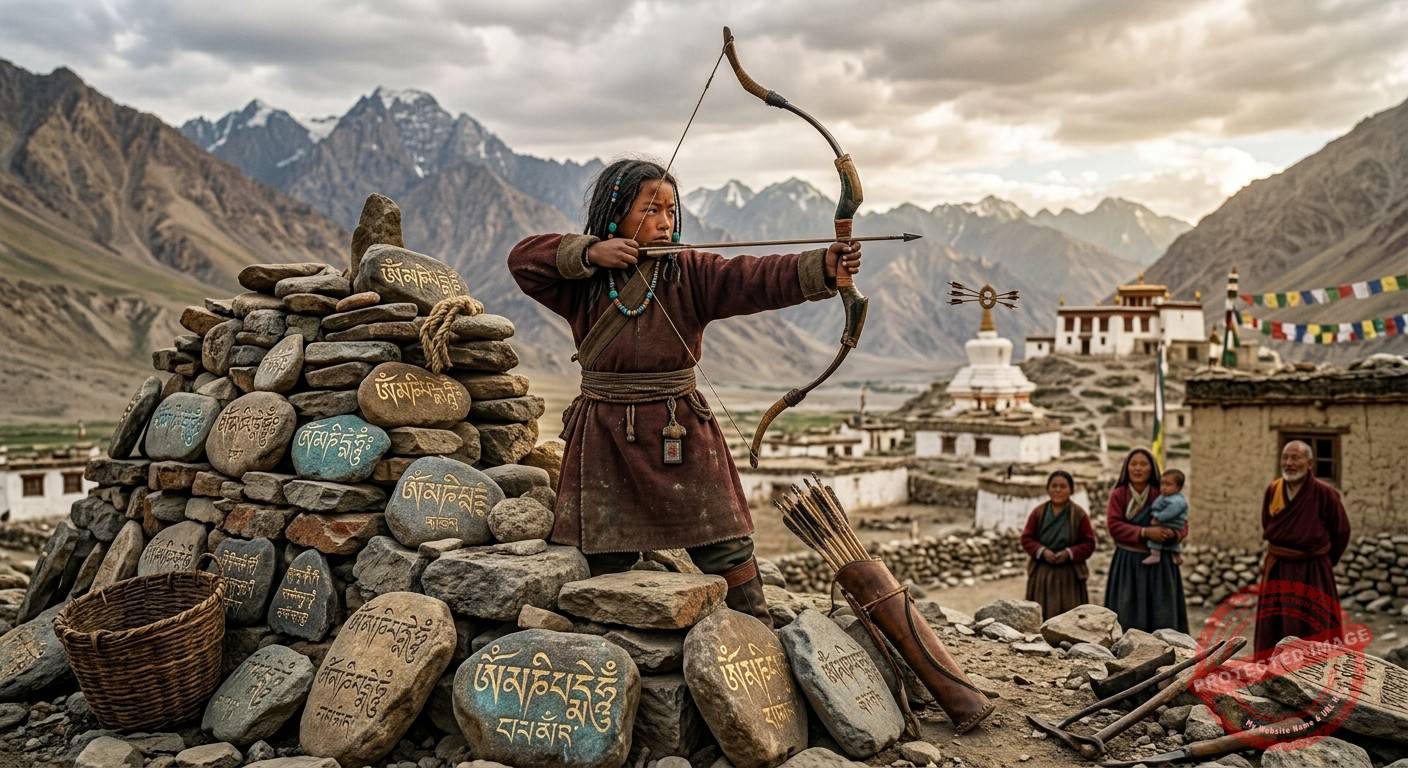
The stories of his childhood reveal how the unusual child grows within the world of Ling and gradually becomes the figure remembered as Kesar. His strength, intelligence, courage, and relationship with the supernatural world begin to emerge while he is still young.
The childhood episodes are therefore not simply stories about a remarkable boy. They are the beginning of the making of the hero.
Kesar’s Childhood
After his extraordinary birth, Kesar enters the world of Ling as a child whose nature is already different from that of ordinary people.
The stories surrounding his early years emphasise his unusual qualities.
He is strong beyond his age.
He possesses extraordinary courage.
He is drawn toward the world beyond the ordinary human experience.
The child who will eventually become the great ruler of Ling is therefore marked from an early age by qualities that foreshadow his later adventures.
His childhood forms a bridge between the miraculous circumstances of his birth and the heroic life that follows.
A Child of Extraordinary Nature
Kesar does not grow like an ordinary child.
The stories describe a young figure whose abilities appear before the people around him are ready to understand them.
His physical strength is remarkable.
His character is independent.
His encounters with danger reveal a courage that is unusual even among those accustomed to hardship.
These qualities are important because the Kesar Saga does not present heroism as something that suddenly appears when the hero becomes an adult.
The foundations of the hero are already present in childhood.
Kesar’s later achievements are therefore understood as the fulfilment of qualities that were visible from the beginning.
The Land Around the Young Hero
Kesar’s childhood is inseparable from the landscape of Ling.
The mountains, valleys, rivers, animals, settlements, and places associated with the kingdom form the environment in which the young hero develops.
The landscape is not simply scenery.
Throughout the Kesar tradition, places can carry memory and meaning. Mountains and valleys can be associated with supernatural beings, heroic encounters, and events that shape the destiny of the kingdom.
The young Kesar grows within this world.
He learns its dangers and its possibilities.
He becomes familiar with the land that he will eventually be expected to protect.
The making of the hero therefore takes place not only through individual adventures but also through his relationship with the world around him.
Kesar and the Supernatural World
The boundary between the human and supernatural worlds remains open throughout Kesar’s childhood.
The same world that produced extraordinary signs at his birth continues to surround him as he grows.
Supernatural beings are not distant ideas in the Kesar tradition. They can appear in mountains, valleys, forests, and other places encountered by human beings.
Kesar’s childhood encounters with this world prepare him for the conflicts that will define his later life.
He learns, directly or indirectly, that strength is not enough.
A hero must understand the forces around him.
He must know when to confront danger, when to seek guidance, and when an apparently simple encounter carries a larger meaning.
These lessons become part of the making of Kesar.
The Teacher
The role of teachers and wise figures is important in the Kesar tradition.
Kesar’s extraordinary abilities do not mean that he requires no guidance.
The world of the epic contains knowledge that cannot simply be gained through physical strength. Understanding supernatural forces, recognising danger, and knowing how to respond to extraordinary circumstances are all forms of knowledge.
The teacher therefore represents another part of the heroic process.
The child possesses potential.
Guidance helps transform that potential into purposeful action.
This relationship between extraordinary ability and learned wisdom becomes important throughout the wider saga.
The Nine-Headed Ogre and the Making of Ling
The encounter with the nine-headed ogre is one of the most significant episodes connected with the young hero.
The ogre belongs to the supernatural world and possesses enormous power.
Yet the encounter ultimately becomes part of the formation of Ling itself.
In the tradition recorded by Francke, the body of the defeated ogre is transformed into elements of the castle and surrounding landscape.
The heads become associated with the great castle.
The legs become beams.
The arms and fingers provide other structural elements.
Other parts of the body become associated with the roof and landscape.
The episode therefore carries a meaning beyond the defeat of a monster.
The young hero’s confrontation with supernatural danger becomes connected with the creation and identity of his kingdom.
Ling is not simply a political territory.
Its very landscape becomes part of the heroic mythology.
The Meaning of the Young Hero
Kesar’s childhood is important because the epic uses the young hero to establish the qualities that will later define the king.
Strength is one of them.
Courage is another.
But the deeper significance lies in responsibility.
The hero’s abilities are not presented as possessions for his own benefit.
They prepare him for a future in which he must confront dangers threatening his people and kingdom.
The childhood stories therefore begin to answer an important question:
What makes Kesar worthy to become the hero of Ling?
The answer is not simply that he is powerful.
It is that his extraordinary abilities are gradually directed toward a larger purpose.
From Child to Hero
The transition from childhood to heroism is gradual.
Kesar’s early experiences establish the foundation for his later identity.
He encounters danger.
He learns from those around him.
He becomes familiar with the supernatural world.
He demonstrates qualities that distinguish him from ordinary people.
And through these experiences, the child becomes increasingly prepared for the larger responsibilities awaiting him.
The Kesar Saga does not need to announce a single moment when the child suddenly becomes a hero.
Instead, heroism emerges through the accumulation of extraordinary experiences.
The young Kesar is already becoming the Kesar who will later cross kingdoms and confront powerful enemies.
Kesar and the Idea of Heroism
The childhood story also reveals how the epic understands heroism.
A hero is not simply the strongest person in the land.
The hero must possess qualities that allow him to protect and lead others.
Courage must be joined with responsibility.
Strength must be joined with wisdom.
And power must ultimately serve the wider community.
These themes become increasingly important as Kesar’s story develops.
The child is therefore being prepared not merely to fight but to rule.
The future king is already present within the young hero.
The Beginning of Ling’s King
The childhood of Kesar marks the beginning of his relationship with kingship.
His identity becomes increasingly connected with Ling and with the people who will depend upon him.
The epic’s later conflicts will involve kingdoms, rival rulers, marriage alliances, supernatural enemies, and the defence of territory.
But those larger struggles have their foundation in the young hero’s early life.
Before Kesar can become the protector of Ling, he must first become Kesar.
His childhood is the period in which that identity begins to take shape.
The extraordinary child of the birth stories is gradually transformed into the heroic figure whose name will become inseparable from the kingdom.
Cultural Context
Childhood episodes in heroic traditions often serve a particular purpose.
They explain why a later hero possesses extraordinary abilities and why the community recognises him as different.
In the Kesar tradition, the childhood of the hero also provides a connection between the supernatural circumstances of his birth and the political world of Ling.
The young Kesar belongs to both worlds.
He is a human child growing within a human community, but his origin and abilities connect him with a supernatural order.
This dual identity becomes one of the defining characteristics of the epic.
The childhood stories also reflect the importance of landscape in Ladakhi oral tradition.
The mountains, valleys, animals, and natural environment are not passive surroundings. They participate in the world of the story and become associated with the memory of heroic events.
The making of Kesar is therefore also the making of a relationship between hero, kingdom, and landscape.
Versions and Variations
As with the birth of Kesar, accounts of his childhood vary across versions of the Kesar Saga.
The wider Tibetan and Ladakhi tradition contains many episodes that are not arranged in exactly the same order.
Some tellings emphasise Kesar’s supernatural origins.
Others place greater attention on his childhood adventures, his strength, his relationship with teachers, or his encounters with supernatural beings.
The Lower Ladakhi tradition recorded by Francke provides one important sequence, but it should not be treated as the only form of the childhood story.
Oral epics develop through performance.
A storyteller may preserve one episode in greater detail than another, combine related motifs, or present events in a different sequence.
The differences are therefore part of the history of the tradition.
Source Notes
The childhood material belongs to the broader Lower Ladakhi Kesar tradition documented by A. H. Francke and preserved within the larger sequence of the epic.
Francke’s work is particularly important because it records an oral tradition at a time when the Kesar Saga was still being transmitted primarily through storytelling.
The childhood episodes should therefore be read together with the birth tradition rather than as an isolated biography of Kesar.
The details of Kesar’s early life vary among traditions, and some elements that are prominent in one regional version may be absent or differently expressed in another.
This chapter follows the established Lower Ladakhi narrative framework while recognising the wider diversity of Kesar traditions.
What Comes Next
The extraordinary child of Ling is now beginning to take his place within the world of the kingdom.
The next chapter turns from childhood to one of the important relationships in Kesar’s life: his relationship with ‘aBruguma, known in the Ladakhi tradition as Duguma.
Their story introduces a new dimension to the epic.
Kesar’s destiny is no longer concerned only with his own transformation into a hero. Marriage, family, loyalty, and relationships between people and kingdoms begin to shape the larger story.
The saga now moves from the making of the hero to the story of Kesar and Duguma.
Chapter Navigation
Previous Chapter:
Ling Kesar — The Birth of Kesar
Next Chapter: