 Writer
Region: Ladakh, especially the Lower Ladakhi tradition
Tradition: Kesar / Gesar epic
Story type: Epic origin story / oral legend
Main figure: Kesar (Gesar), also associated in the Ladakhi tradition with Ling and the name Ling Norbu Dadul
Source tradition: Lower Ladakhi oral traditions recorded by A. H. Francke
Kesar Saga Chapters
- The Prologue to the Kesar Saga
- The Birth of Kesar
- Kesar’s Childhood and the Making of the Hero
- The Story of ‘aBruguma’s Marriage to Kesar
- Kesar’s Journey to China
- Kesar’s Marriage to gYui dKon mChogmo
- The Northern Giant
- The Capture of ‘aBruguma by the King of Hor
- The Defeat of the King of Hor
This sequence forms the principal structural basis for this website series.
Short Excerpt
Before Kesar became the great king of Ling, before his battles and journeys, the old stories tell of a birth unlike that of an ordinary child.
In one Lower Ladakhi tradition, the story begins not in a royal palace but in a humble field. Grain grows miraculously, is gathered into a storehouse, and then mysteriously changes into worms. From the last and greatest of these worms comes a beautiful child, extraordinary in appearance and destiny.
Other Ladakhi versions tell the birth differently: the mother Gogzalhamo gives birth amid hail, light, animals, mountains and the elements of the natural world. In another version, darkness covers the earth while a brilliant light appears around the mother’s house, and the child is born with supernatural signs.
These variations are not mistakes. They are part of the living oral tradition of Kesar.
The Birth of Kesar
Long before the name Kesar became known across the mountains, there was the land of Ling.
The story begins in an age when the boundaries between the human world, the world of the gods and the world of spirits were not sharply separated. Mountains could become beings, animals could carry extraordinary powers, and a child born on earth might have a destiny that had begun far above it.
The old Ladakhi Kesar tradition preserves several beginnings to this story. What follows is a literary retelling based principally on the Lower Ladakhi material recorded by the missionary and scholar A. H. Francke, while preserving the distinctive elements of the older narrative rather than attempting to combine every version into one supposedly definitive account.
The First Beginning
In Francke’s recorded prologue, the story reaches back to an ancestral age in the land called Kalahol.
There lived an ancestor named bKras-shis and his wife.
They possessed only a small field. They borrowed seed from another person and planted it, hoping for a harvest sufficient to sustain them.
But what grew from their field was no ordinary crop.
Only a single plant appeared.
They cared for it carefully. They watered it and watched it grow until it became a great tree. From this tree came an extraordinary harvest of wheat and barley. The grains were said to be enormous—each one as large as a pigeon.
The harvest was gathered and placed in a barn.
It seemed that abundance had finally come to the household.
But the miracle did not end there.
When the ancestor returned to inspect the grain, he discovered that the harvest had changed.
The grains had become worms.
The worms began to consume one another until only one remained.
It grew enormous, filling the barn.
For seven days it remained there.
Then, when the ancestor returned again, the creature had changed.
The great worm had become a child.
The child was extraordinarily beautiful and delicate. The old account describes him as so tender that the heat of the sun could melt him, while the cold of the shade could freeze him.
Golden hair fell from his forehead to his chest, and a silver-coloured braid descended down his back.
This was no ordinary birth.
The ancestor sought the advice of a teacher named Tse-dgu, who lived in a hermitage in what the story calls the “cold valley.”
He asked what name should be given to the extraordinary child.
The teacher gave him a name: Dong-yum Mila-sngonmo.
The story had begun to reveal that the child belonged to a world larger than the ordinary human world.
The Child and the Nine-Headed Ogre
The child grew.
He loved to go hunting, accompanied by two dogs.
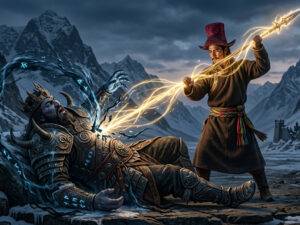
One day the dogs encountered an enormous ogre with nine heads on a rock above the teacher’s hermitage.
The creature was terrifying, but it did not immediately attack.
Instead, it pleaded for its life.
The ogre promised the boy that, if spared, it would become his companion and helper in war and sport.
The child did not know what to do.
He returned to the teacher and asked for advice.
The teacher gave him a different command.
The ogre must die.
Its death would not simply be the destruction of a monster. From its body, the land of Ling itself would come into existence.
Its heads would become parts of the great castle.
Its legs would become beams.
Its arms would provide smaller timbers.
Its fingers would become roof supports.
Its ribs would become branches for the roof.
Its inner parts would become the earth of the roof.
Even the lungs and heart would become parts of the sacred landscape associated with Ling.
Thus, in this extraordinary telling, the kingdom of Ling is not merely built by human hands.
It is born from the body of a supernatural being.
The landscape itself becomes part of the myth.
And the child at the centre of the story is moving steadily toward the destiny that will eventually make him Kesar.
Another Birth: Gogzalhamo and the Hail
The Lower Ladakhi Kesar tradition does not preserve only one account of Kesar’s birth.
Francke recorded additional versions from oral material.
In one of them, Gogzalhamo sits spinning in her room while hail falls outside.
She is hungry.
She eats some of the hailstones.
After this, she conceives.
The storm affects the entire world around her.
Animals flee from the falling hail.
The horses run away, but one mare remains behind longer than the others.
The dogs flee, but one she-dog remains.
The sheep flee, but one ewe remains.
The goats flee, but one goat remains.
These animals are not incidental.
They too become part of the miraculous birth.
The mare gives birth to an extraordinary foal.
The dog gives birth to a remarkable puppy.
The ewe gives birth to a lamb.
The goat gives birth to a kid.
The birth of the future hero is therefore accompanied by the birth of extraordinary animal companions and creatures.
Human beings and animals share the same supernatural moment.
The Birth Across the Elements
Another recorded version expands the birth into an almost cosmic journey.
Gogzalhamo hears a voice within her.
The unborn child tells her that he must be born in a particular place.
She goes first toward the lofty sky.
There she gives birth to the sun and moon.
But the voice tells her that these are not yet the child she carries.
She continues.
She gives birth to a white ice-lion upon a high mountain.
Still the voice tells her to continue.
She travels onward to a lofty rock, where a wild bird-king is born.
The journey continues through different parts of the natural world.
On the steppe comes a horse.
In the sea comes a little fish.
In the meadow comes a wild yak.
In the forest comes a rat.
In the field comes a small bird.
Other versions associate further births with different places and animals.
Only after these supernatural manifestations does Gogzalhamo finally give birth to the child himself.
The story therefore places Kesar’s birth inside the whole landscape of the world.
The mountains, animals, water, sky and earth appear almost as members of the same cosmic family.
The Child of Light
A third recorded birth version is even more dramatic.
Darkness covers the earth.
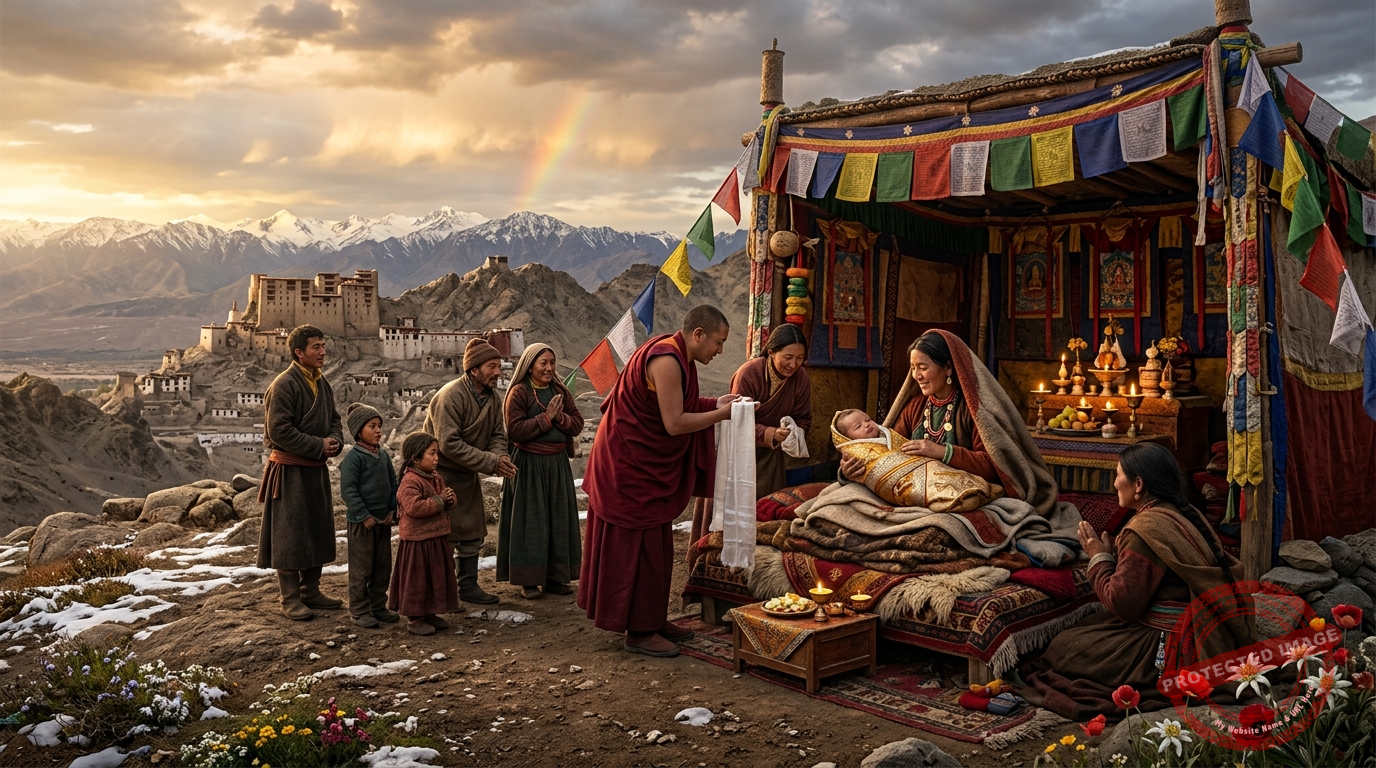
Yet around Gogzalhamo’s house there appears a brilliant light.
Inside the house, the unborn child troubles his mother until finally he emerges—not through an ordinary birth, but between her ribs.
The birth causes her no pain.
The child is extraordinarily beautiful.
He possesses golden hair and wings.
His arrival transforms the house.
The fire rises by itself.
Food is prepared without ordinary effort.
A sweet fragrance fills the room.
Jewels rain down.
And the child grows with astonishing speed—what would take another child a month takes him only a day.
This is the birth of a being whose nature is already beyond ordinary human measure.
More Than a Hero
The different birth stories reveal something important about Kesar.
He is not introduced simply as a warrior who will later become powerful.
His extraordinary nature is announced from the beginning.
Light surrounds his birth.
Animals are born alongside him.
Mountains and landscapes participate in his story.
He possesses supernatural qualities.
And in some traditions, his earthly birth is understood as the continuation or rebirth of a heavenly existence.
Francke’s research records the Ladakhi name Dongrub in connection with Kesar and identifies him with the son of the heavenly king who is born on earth as Kesar.
The same research also records a Ladakhi interpretation of the name Kesar as connected with the idea of being newly born or reborn.
These interpretations belong to Francke’s historical documentation and analysis and should not be treated as a universally accepted modern etymology. They nevertheless show how strongly the ideas of birth, return and transformation were connected with Kesar in the Ladakhi tradition.
From Child to Kesar
The birth is only the beginning.
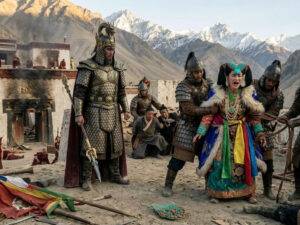
The supernatural child will grow into the figure remembered as Kesar of Ling.
He will become connected with the kingdom of Ling.
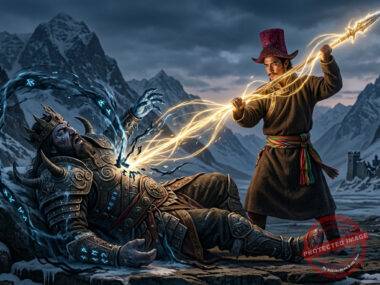
He will face challenges from supernatural beings and rival rulers.
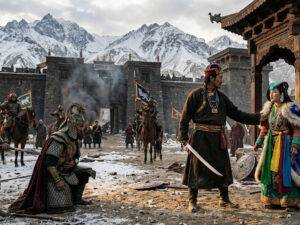
He will encounter Duguma, travel far beyond his homeland, confront giants and enemies, and eventually fight the King of Hor.
The later epic is enormous.
But its first movement is much smaller:
a field,
a strange harvest,
a miraculous transformation,
a mother,
a child,
and a world waiting for him.
The story of Kesar therefore begins not with a battlefield but with birth.
The hero who will eventually cross mountains and kingdoms first has to enter the human world.
And from the moment he arrives, the old storytellers tell us that the ordinary rules of that world no longer quite apply.
Cultural Context
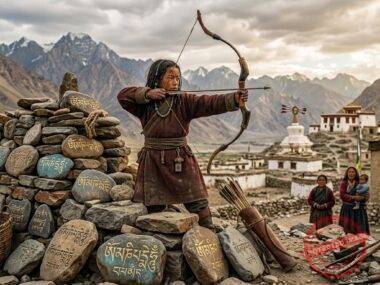
The Kesar story occupies a distinctive place in Ladakhi storytelling.
It is part of a much larger epic tradition known across the Tibetan cultural world and beyond. The Indira Gandhi National Centre for the Arts describes the Kesar Saga as an ancient Tibetan epic whose Ladakhi form has been transmitted orally for centuries, traditionally recited by storytellers during long winter nights.
In Ladakh, the story is known in different forms and under different names. A Ladakh Studies account notes that Kesar may be called Gyalam Kesar or Ling Norbu Dadul, and records the tradition as having numerous local versions. It also emphasizes that Kesar is an epic that can take several days to tell, unlike shorter folk stories.
The birth episode is especially significant because nature is not simply a background to the story.
Animals, mountains, weather, celestial bodies and supernatural beings participate in the narrative.
The extraordinary births of animals alongside the hero suggest a world in which the boundaries between human and non-human existence are fluid. This is one of the distinctive characteristics of the older mythic material recorded by Francke.
The story also connects the birth of the hero with the formation of Ling itself. In the Lower Ladakhi prologue, the body of the nine-headed ogre becomes the material from which the castle and landscape of Ling are formed.
Francke’s early research went further and proposed that Kesar material was connected with a broader gLing-chos, or mythology associated with Ling. His interpretation was influential but also explicitly theoretical; it should therefore be presented as historical scholarship rather than as an established explanation of the epic’s origins.
Versions of the Birth Story
There is no single universally authoritative Ladakhi version of Kesar’s birth.
Francke specifically documented several versions.
1. The miraculous child from the worm
In the prologue of the Lower Ladakhi version published in 1909, the story begins with the ancestor bKras-shis, a miraculous harvest, worms and the transformation of the final worm into a beautiful child.
2. Gogzalhamo and the hail
In another recorded version, Gogzalhamo eats hailstones while sitting inside her room. She conceives, and the birth of the hero is accompanied by the birth of extraordinary animals.
3. The journey through the natural world
Another version has Gogzalhamo following the voice of the unborn child through the sky, mountains, rocks, steppe, sea, meadow, forest and fields before finally giving birth to him.
4. The birth of light
A further version describes darkness covering the earth while brilliant light appears around the mother’s house. The child emerges between his mother’s ribs and is accompanied by miraculous signs including self-igniting fire, food, fragrance and jewels.
These should not necessarily be forced into one continuous story.
They represent the richness of an oral tradition in which different communities and storytellers preserved different forms of the same great narrative.
Francke himself observed that Kesar stories could change considerably from one village to another and that oral versions were transmitted by memory rather than simply copied from a written epic.
Why the Birth Story Matters
The birth of Kesar establishes several themes that continue throughout the epic:
Transformation — ordinary things become extraordinary.
Nature and the supernatural — animals, mountains, weather and celestial bodies participate in the story.
Destiny — Kesar’s greatness is present from birth rather than acquired only through later victories.
Ling — the kingdom is not merely a political territory but part of the mythic world created around the hero.
Rebirth — some Ladakhi interpretations connect Kesar with a heavenly existence returning to earth.
Oral tradition — the existence of multiple birth stories demonstrates that the Kesar tradition is not a single fixed literary narrative.
For a modern reader, these differences are not weaknesses in the tradition. They are evidence of how the story lived through generations of storytellers.
Source Notes
The principal historical source for this page is Rev. A. H. Francke’s A Lower Ladakhi Version of the Kesar-Saga, published in Calcutta in 1909. The digitized edition identifies a dedicated section covering “The story of Kesar’s birth”, with the Tibetan text occupying pages 30–63 and Francke’s abstract, notes and vocabulary occupying pages 64–83.
Francke’s earlier studies in The Indian Antiquary are particularly valuable for understanding the variations in the birth story. They record several versions obtained from oral traditions and explicitly note that the Kesar Saga was told differently in different villages.
The broader oral character of the tradition is also documented by the Ladakh Studies archive, which describes Kesar as an epic that can take several days to perform and notes the existence of different local versions.
The IGNCA’s documentation likewise describes the Ladakhi Kesar Saga as an oral tradition transmitted across generations by storytellers.
Editorial note
This page is a modern English narrative adaptation, not a word-for-word translation of Francke’s Tibetan text. Where multiple traditional versions exist, they are identified as separate versions rather than silently merged. Some names and spellings vary between historical sources and modern Ladakhi usage; future editions of this website should therefore preserve the original source spelling alongside a reader-friendly form wherever possible.
What Comes Next
The birth of Kesar establishes the extraordinary nature of the child, but the hero has only just entered the world.
The next chapter follows Kesar’s childhood and the making of the hero. It explores the young Kesar as he grows within the world of Ling, the signs of his unusual nature, his encounters with the supernatural, and the experiences that begin to shape him into the heroic figure he is destined to become.
The story now moves from birth to childhood—from the mystery of where Kesar came from to the making of the hero he will become.
Chapter Navigation
Previous Chapter:
Ling Kesar — Prologue to the Kesar Saga
Next Chapter: