 Writer
Ling Kesar — Kesar’s Journey to China
Region: Ladakh, particularly the Lower Ladakhi tradition
Tradition: Kesar / Gesar epic
Story type: Epic / heroic legend / journey tale
Main figure: Kesar of Ling
Previous chapter: The Story of ‘aBruguma’s Marriage to Kesar
Next chapter: Kesar’s Marriage to gYui dKon mChogmo
Kesar Saga Chapters
- The Prologue to the Kesar Saga
- The Birth of Kesar
- Kesar’s Childhood and the Making of the Hero
- The Story of ‘aBruguma’s Marriage to Kesar
- Kesar’s Journey to China
- Kesar’s Marriage to gYui dKon mChogmo
- The Northern Giant
- The Capture of ‘aBruguma by the King of Hor
- The Defeat of the King of Hor
This sequence forms the principal structural basis for this website series.
Short Excerpt
Kesar’s story does not remain within the boundaries of Ling.
After the events surrounding his marriage to Duguma, the hero’s journey expands beyond his homeland and toward a distant kingdom identified in the Lower Ladakhi tradition as China.
The journey is not an ordinary expedition.
Kesar encounters mysterious landscapes, supernatural powers, difficult roads and a distant king whose suffering becomes connected with the extraordinary abilities of the hero.
In the traditional account recorded by A. H. Francke, Kesar spends a period at a hermitage near the white, black and red hills before revealing his supernatural power to the King of China.
The journey therefore becomes another test of the hero—and another stage in the expansion of his world.
Beyond the Kingdom of Ling
Kesar has already passed through the important stages of his early life.
He was born under miraculous circumstances.
He grew into an extraordinary child.
He became connected with Ling.
He married Duguma.
But the great Kesar Saga is not confined to one kingdom.
The hero’s destiny requires him to travel.
Beyond Ling lies a wider world of kingdoms, rulers, supernatural beings and distant lands.
Among these distant places is the kingdom described in the Lower Ladakhi tradition as China.
The journey marks a significant change in the scale of the story.
Kesar is no longer dealing only with events within his own homeland.
He is entering a world governed by unfamiliar rulers and forces.
The Seven Kingdoms
Francke’s recorded account begins this episode after Kesar has subdued seven kingdoms.
The statement is characteristic of the scale of the epic.
Kesar is already presented as a powerful hero whose reputation and influence extend beyond Ling.
Yet even after these victories, another challenge remains.
He does not know the road to China.
The distance is not simply geographical.
It represents another stage of the hero’s movement into the unknown.
The Kesar Saga repeatedly places its hero before places that ordinary people cannot easily reach.
The road itself becomes part of the adventure.
The White, Black and Red Hills
Unable to find the road to China, Kesar goes to a hermitage near three hills described as white, black and red.
The place becomes important in the next stage of his journey.
Rather than immediately entering the foreign kingdom, Kesar remains at the hermitage.
The episode gives the story a pause.
The hero waits.
The world beyond him continues to exist, but the journey has not yet reached its appointed moment.
This waiting is not presented as weakness.
It is part of the extraordinary plan of the hero.
Three Years at the Hermitage
Kesar intends to remain at the hermitage for three years.
During this period, he prepares to demonstrate his supernatural power to the King of China.
The length of the waiting period is important.
In an ordinary journey, a traveller might simply continue along the road.
Kesar’s journey follows a different logic.
Time itself becomes part of his power.
He waits until the moment is right.
The hermitage therefore becomes a place of preparation.
The Goat Kabulu
Beneath the hermitage, Kesar places a goat named Kabulu.
The goat becomes part of the extraordinary mechanism through which Kesar’s power reaches the distant Chinese kingdom.
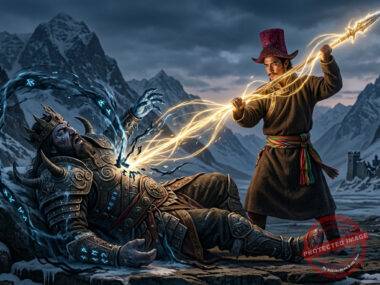
According to Francke’s abstract, when two and a half years have passed, Kesar reveals his supernatural power to the King of China while still at the hermitage.
The event demonstrates that physical distance does not limit the hero.
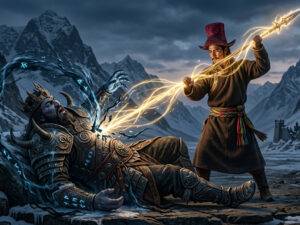
Kesar does not need to stand before the foreign king in order to affect him.
His power can cross the distance between the hermitage and the distant kingdom.
The Castle of the King of China
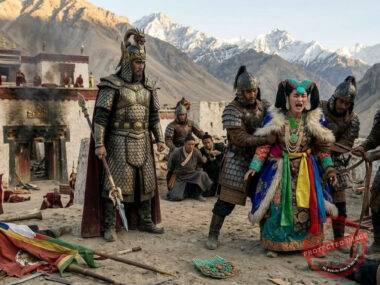
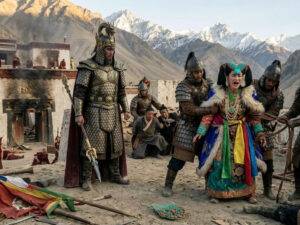
When Kesar displays his power, an extraordinary event takes place.
Part of the King of China’s castle breaks apart.
At the same time, the king himself begins to suffer severe pain in his heart.
The event immediately alarms the royal household.
The king’s advisers, diviners and astrologers are called upon to determine the cause of the disaster.
They discover that the misfortune has been caused by Kesar.
The mysterious power of the hero has reached a kingdom he has not yet entered.
The journey has therefore begun before Kesar physically arrives.
The King’s Suffering
The Chinese court does not initially understand why the king has become ill.
The collapse of part of the castle and the king’s suffering appear to be connected.
The diviners identify Kesar as the cause.
Their conclusion is clear:
Kesar himself must come.
There is no other way to cure the king.
This creates an unusual reversal.
The distant kingdom does not simply wait for the hero to arrive.
It actively seeks him.
The journey to China is therefore initiated through the recognition of Kesar’s extraordinary power.
The First Messenger
The Chinese are afraid to send an ordinary man to Kesar.
They fear that their messenger could be killed.
Instead, they send a bird named dorre carrying a letter.
The bird reaches Kesar and delivers the message.
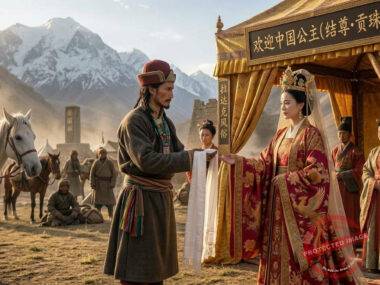
The King of China promises to give Kesar whatever he desires if he will come.
But Kesar refuses.
The hero does not accept the invitation simply because the foreign king promises him gifts.
He insists that the request must come through a human messenger.
The supernatural journey therefore continues to unfold according to Kesar’s own terms.
The Man Made from Earth
The King of China then takes a remarkable step.
He cuts his own hand.
He mixes his blood with earth.
From this mixture he forms a man.
He gives the man life by breathing into him and sends him to Kesar.
The strange messenger reaches Kesar.
He throws the letter before the hero.
Then he disappears.
The episode is one of the clearest examples in this part of the saga of the supernatural world operating through kings and kingdoms.
The Chinese king himself possesses extraordinary powers.
Yet those powers exist within a world in which Kesar’s abilities are greater still.
Kesar Waits for the Right Moment
Although the Chinese king has now sent a human messenger, Kesar does not immediately depart.
The three-year period at the hermitage has not yet ended.
The hero therefore remains where he is.
Meanwhile, he sends Agu Khrai Vigo Khrai Thung ahead.
The messenger does not know the road.
A dark fog appears, and he becomes delayed on the journey.
The episode reinforces one of the recurring characteristics of the Kesar Saga.
The roads of the epic are not ordinary roads.
Distance, weather, supernatural forces and destiny can all interfere with travel.
The journey is therefore an adventure in itself.
The Completion of Three Years
At last, the three years at the hermitage are completed.
Only now is Kesar ready to leave.
He kills the goat Kabulu and gives her flesh to the birds of prey.
The waiting period has ended.
The preparations for the journey can now begin.
Kesar’s departure is therefore not simply the decision of a traveller who has chosen a destination.
It comes after a period of waiting, supernatural preparation and communication with a distant kingdom.
The journey begins at the moment determined by the story’s larger destiny.
The Gifts Kesar Requests
Before setting out, Kesar goes to father bsTanpa and mother sNgonmo.
He asks them to provide him with extraordinary objects for the journey.
Among the things requested are:
- a basket capable of holding valleys and hills;
- a leather bag capable of holding deserts;
- a pot capable of holding the waters of rivers;
- a bundle of sinews from lice;
- the blood of red beetles;
- and other extraordinary materials.
These objects immediately show that Kesar’s journey cannot be understood as an ordinary geographical expedition.
The hero is preparing for a world in which landscapes themselves can be contained, transformed or carried.
The scale of the objects mirrors the scale of the epic.
Mountains, valleys, deserts and rivers become elements within the hero’s supernatural equipment.
The Hero Who Carries the Landscape
The objects requested by Kesar are particularly striking because they reflect the relationship between the hero and the natural world.
In earlier chapters, the landscape of Ling was already part of Kesar’s story.
Mountains, animals and supernatural beings participated in his birth and childhood.
Now the landscape becomes something the hero can symbolically carry with him.
The journey therefore continues one of the central ideas of the Kesar tradition:
Kesar does not simply travel through the landscape. He possesses an extraordinary relationship with it.
The mountains, valleys, rivers and deserts belong to the mythic world through which the hero moves.
China as the Distant Kingdom
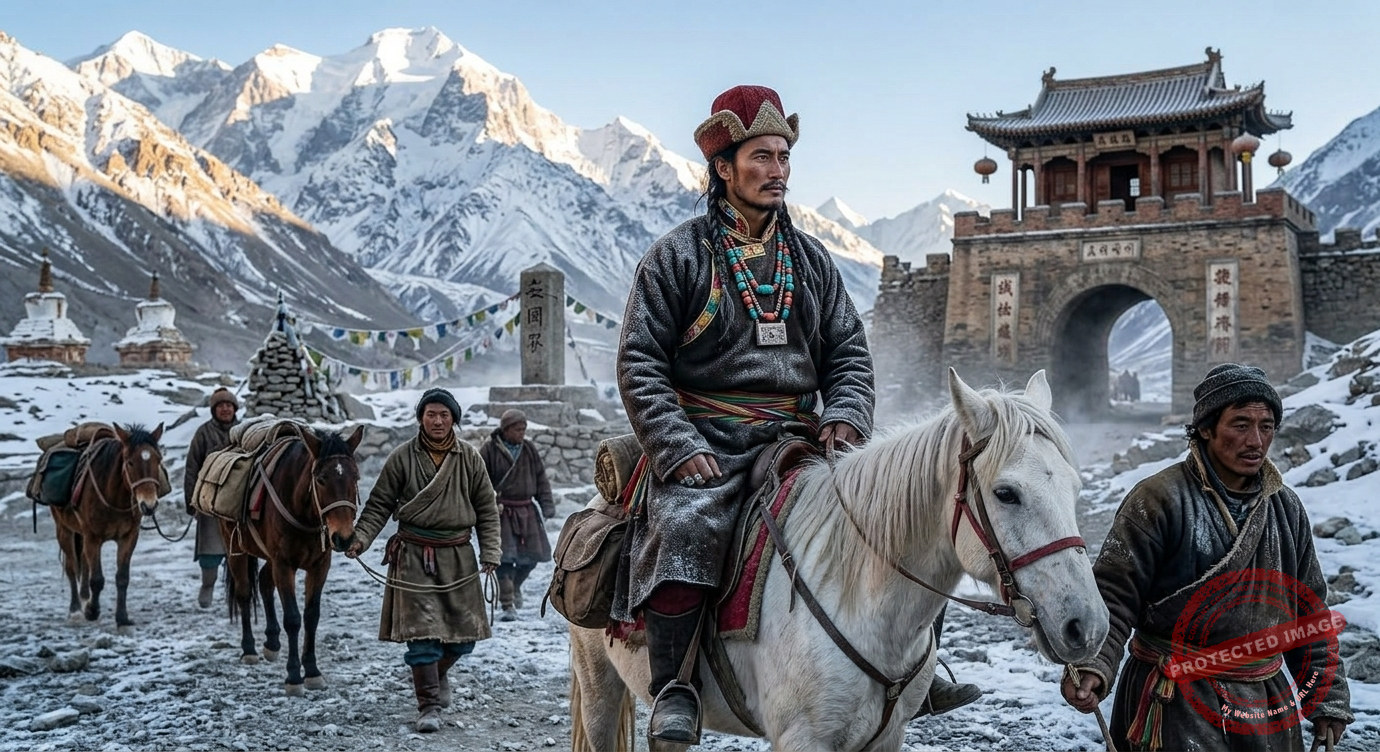
The China of the Kesar Saga should be understood within the geography of the epic tradition.
The narrative presents it as a distant and powerful kingdom ruled by its own king and court.
It is not necessary to identify every location in the story with a precise historical place.
Epic geography often combines remembered places, distant kingdoms, supernatural landscapes and legendary geography.
The important point within this narrative is that China represents a world beyond Ling.
Kesar is moving into a foreign political and cultural sphere.
There he will encounter a new royal household.
And at the centre of that household will be gYui dKon mChogmo.
The Journey as a Test
Kesar’s journey to China is another stage in the testing of the hero.
The challenge is not simply physical distance.
He must deal with:
Distance — the road to China is difficult to find.
Time — he must wait for three years.
Supernatural forces — his power reaches the distant king before he arrives.
Unknown territory — the journey takes him beyond the familiar world of Ling.
Foreign kingship — he enters the sphere of another powerful ruler.
Each stage prepares Kesar for the next chapter of his life.
The hero who once belonged primarily to Ling is becoming a figure whose story crosses kingdoms.
From Ling to the Wider World
The journey also changes the scale of Kesar’s identity.
He is still Kesar of Ling.
But he is no longer known only through the affairs of his own homeland.
His reputation has travelled.
His power is recognised by distant rulers.
Foreign kingdoms respond to his actions.
The hero’s world has expanded.
This is one of the defining characteristics of the Kesar epic.
The story continually pushes the hero beyond the boundaries of the familiar.
Every new kingdom brings another challenge.
Every journey adds another part to the legend.
The Road to gYui dKon mChogmo
Kesar’s journey to China leads directly into the next major episode of the saga.
The foreign king has already been forced to acknowledge Kesar’s supernatural power.
The hero is now approaching a new royal world.
Within that world is gYui dKon mChogmo.
Her story will become connected with Kesar’s journey and with his second great marriage.
The journey therefore does not end simply with Kesar reaching a distant country.
It leads to another transformation in his life.
A New Chapter of Destiny
Kesar’s journey to China marks the beginning of a new stage.
He has left the immediate world of Ling.
He has crossed into the sphere of a distant king.
His supernatural power has already been demonstrated.
And the road ahead will bring him into contact with another royal household.
The hero’s life is becoming increasingly connected with distant kingdoms and people beyond his homeland.
But the journey also foreshadows an important theme of the later epic.
Kesar may travel far from Ling, but the relationships and responsibilities of Ling will continue to shape his destiny.
Cultural Context
Journeys occupy an important place in heroic epic traditions.
The hero leaves the familiar world and enters unknown territories where his abilities are tested.
In the Kesar tradition, these journeys are especially expansive.
Kesar’s story moves between kingdoms, supernatural landscapes and distant courts.
The journey to China is therefore not merely a travel episode.
It demonstrates the geographical imagination of the epic and expands the world in which Kesar operates.
The Lower Ladakhi version recorded by Francke places this episode directly after the marriage of ‘aBruguma and before the story of Kesar’s victory over the giant of the North. The 1909 edition preserves the China journey and the marriage to gYui dKon mChogmo as one textual section, while the website series separates the journey and the marriage into two chapters in order to follow the broader narrative structure.
Versions and Variations
The Kesar tradition exists in many regional and oral forms.
The geography of Kesar’s journeys can therefore vary between traditions.
Names of rulers, places and characters may also appear in different spellings or forms.
The name gYui dKon mChogmo, for example, is preserved in Francke’s transcription, while modern retellings may use different transliterations.
The identification of the epic’s China with a specific historical location should likewise be approached cautiously.
For this website, the journey is presented as part of the Lower Ladakhi epic tradition, while distinguishing the legendary geography of the saga from claims about precise historical geography.
Source Notes
The principal historical source for this chapter is A. H. Francke’s A Lower Ladakhi Version of the Kesar-Saga, published in Calcutta in 1909.
Francke’s contents place the Tibetan text of “Kesar’s journey to China and marriage to gYui dKon mChogmo” on pages 139–153, followed by the English abstract, vocabulary and comments on pages 154–163.
The abstract records the major elements of the journey: Kesar’s seven kingdoms, his stay at the hermitage near the white, black and red hills, the goat Kabulu, his supernatural effect on the Chinese king, the bird messenger, the man created from the king’s blood and earth, the completion of the three-year period, and the extraordinary objects Kesar requests before beginning the journey.
Editorial note
This chapter is a modern English narrative adaptation based on the Lower Ladakhi material recorded by Francke.
The geographical references to China and the surrounding journey belong to the epic narrative and should not automatically be read as precise historical geography.
Names have been retained as closely as practical to Francke’s transcription while allowing reader-friendly English presentation.
What Comes Next
Kesar has finally crossed the boundary of his familiar world.
The journey to China has brought him before a distant royal court and demonstrated his extraordinary power to a foreign king.
But the journey is not the end of the episode.
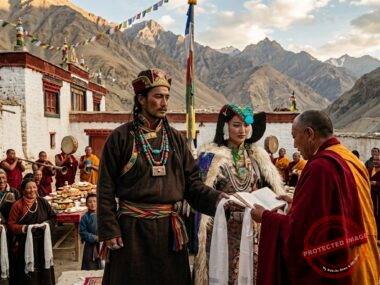
Within this new kingdom, Kesar will encounter gYui dKon mChogmo.
Their meeting will lead to another marriage and another important relationship in the life of the hero.
The saga now moves from Kesar’s journey across distant lands to his marriage to gYui dKon mChogmo.
Chapter Navigation
Previous Chapter:
Ling Kesar — The Story of ‘aBruguma’s Marriage to Kesar
Next Chapter: