 Writer
Ling Kesar — The Capture of ‘aBruguma by the King of Hor
Region: Ladakh, particularly the Lower Ladakhi tradition
Tradition: Kesar / Gesar epic
Story type: Epic / heroic legend / captivity and war tale
Main figure(s): Kesar of Ling, ‘aBruguma (Duguma), the King of Hor
Previous chapter: The Northern Giant
Next chapter: The Defeat of the King of Hor
Kesar Saga Chapters
- The Prologue to the Kesar Saga
- The Birth of Kesar
- Kesar’s Childhood and the Making of the Hero
- The Story of ‘aBruguma’s Marriage to Kesar
- Kesar’s Journey to China
- Kesar’s Marriage to gYui dKon mChogmo
- The Northern Giant
- The Capture of ‘aBruguma by the King of Hor
- The Defeat of the King of Hor
This sequence forms the principal structural basis for this website series.
Short Excerpt
Kesar had travelled far from Ling.
He had crossed distant lands, entered the royal world of China, married gYui dKon mChogmo, and journeyed north to confront the giant of the North.
But while Kesar was away, a new danger was approaching his homeland.
The King of Hor turned his attention toward Ling.
His campaign would bring war to Kesar’s kingdom and, more importantly, would separate Kesar from ‘aBruguma, his first wife.
The capture of ‘aBruguma changes the direction of the entire epic.
Until this point, Kesar’s adventures have largely been journeys of discovery, supernatural encounters and heroic conquest.
Now his story becomes a story of loss and return.
The hero must learn what has happened to his kingdom.
He must cross enemy territory.
And he must prepare to confront the ruler who has taken his wife.
Kesar in the North
The previous chapter ended with Kesar’s victory over the giant of the North.
Kesar had travelled into the northern country and defeated a supernatural adversary.
But the victory did not bring him immediately back to a peaceful Ling.
The epic now turns away from the northern adventure and toward the kingdom that Kesar had left behind.
While Kesar was away, the political situation in Ling changed.
The King of Hor entered the story as a new and more direct threat.
Francke’s own description of the Lower Ladakhi sequence places the capture of ‘aBruguma immediately after Kesar’s victory over the giant of the North and immediately before Kesar’s defeat of Hor.
The King of Hor
The King of Hor is one of the principal enemies in the later part of the Kesar Saga.
In Francke’s earlier discussion of the Kesar mythology, the King of Hor is identified as Gur-dkar. Francke also connects the Hor episode with the wider mythology of Ling and with the conflict between Kesar and the ruler who abducts ‘aBruguma.
The conflict is therefore more than a personal disagreement between two individuals.
Hor represents an opposing political power.
Its king has the ability to threaten Ling itself.
The capture of ‘aBruguma becomes the event that brings Kesar and Hor into direct confrontation.
The Invasion of Ling
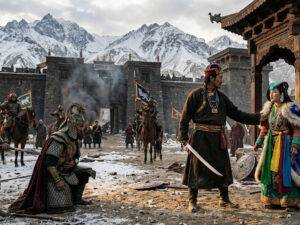
While Kesar is away, the King of Hor advances against Ling.
The land of Ling is overrun.
This is a major change from the earlier episodes of the saga.
Kesar had previously travelled into the territories of supernatural enemies.
Now the danger comes into his own kingdom.
The hero is no longer the one entering another ruler’s territory.
His own homeland has become the place under attack.
A later summary of Francke’s account describes the episode as the King of Hor overrunning Ling while Kesar was away and taking ‘aBruguma captive.
‘aBruguma in Ling
‘aBruguma remains in Ling while Kesar is away.
She is the queen and wife whose relationship with Kesar was established much earlier in the saga.
Her importance to the story has already been established through the marriage episode.
Now her position becomes central to the conflict between Ling and Hor.
The enemy is not simply attacking a distant territory.
The King of Hor takes the woman who stands at the centre of Kesar’s household.
The political conflict therefore becomes deeply personal.
The Capture of ‘aBruguma
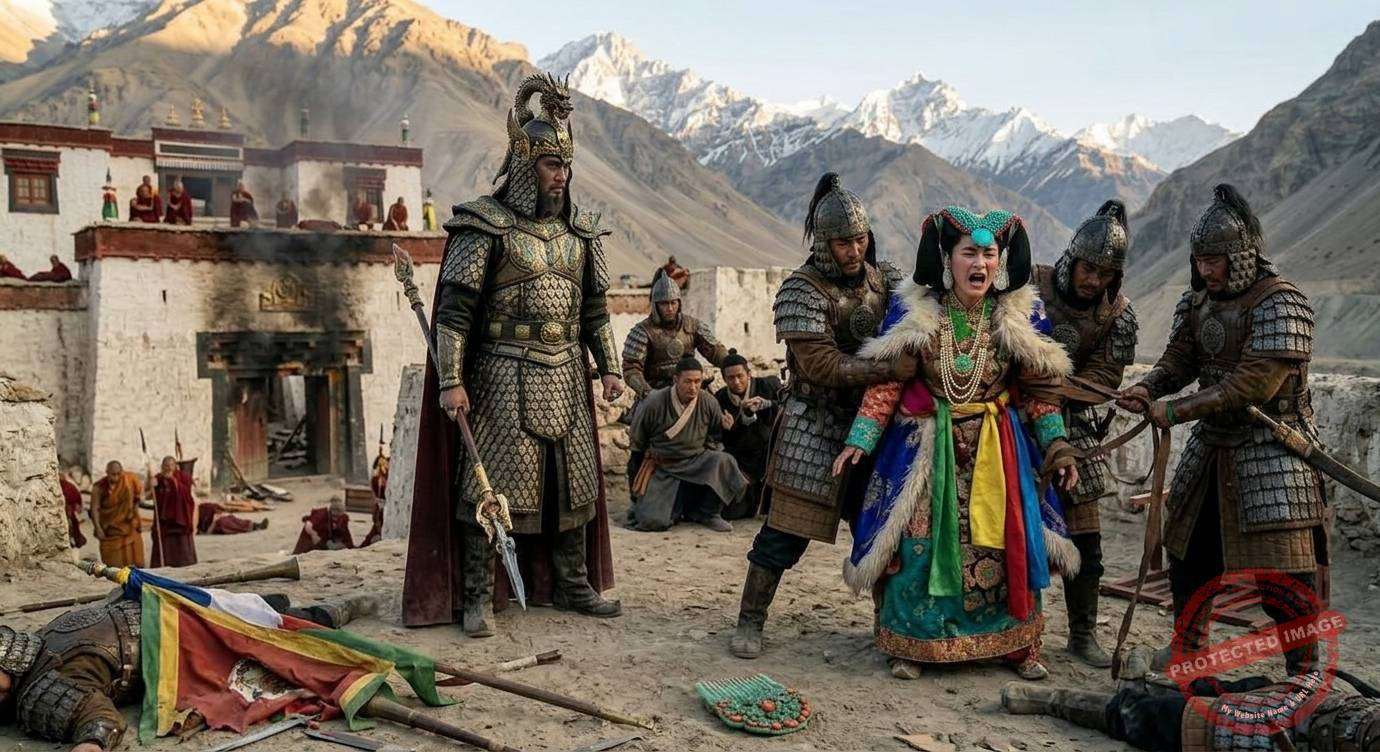
The King of Hor succeeds in taking ‘aBruguma away from Ling.
Her capture becomes one of the great turning points of the Kesar Saga.
The earlier marriage between Kesar and ‘aBruguma had created a bond between the hero and his household.
Now that bond is broken.
Kesar is separated from his wife.
Ling is separated from its king.
And Hor has created a conflict that cannot be resolved without a confrontation.
Francke’s publication gives this entire episode its own section, “Capture of ‘aBruguma by the king of Hor,” occupying pages 200–242 of the Tibetan text.
News Reaches Kesar
Kesar is far from Ling when the disaster occurs.
The epic therefore requires a way for the news to reach him.
In the Lower Ladakhi tradition, the message is carried to Kesar by birds.
The news tells him that Ling has been attacked and that ‘aBruguma has been taken by the King of Hor.
The message transforms Kesar’s situation immediately.
His northern adventure is no longer the most important matter.
His wife and kingdom are in danger.
He must return.
The Journey Toward Hor
Kesar sets out to recover ‘aBruguma.
But the hero does not simply approach Hor with a large army and announce his identity.
The journey becomes another test of his ability to adapt.
Kesar enters the land of his enemy.
He must move through an unfamiliar world.
And instead of immediately revealing himself as the great king of Ling, he takes on another identity.
Kesar the Smith
In the land of Hor, Kesar takes service with a smith.
This is one of the distinctive episodes of the Hor story.
The great king becomes a worker.
The hero who has defeated giants and crossed supernatural territories now learns and practises the trade of a craftsman.
The transformation is important.
Kesar does not depend only upon royal status.
He is capable of entering the ordinary world and using practical knowledge to accomplish a greater purpose.
Francke’s wider account specifically records that Kesar takes service at a smith’s and learns the smith’s trade.
The Hidden Hero
Kesar’s identity is concealed.
The King of Hor does not simply face the famous king of Ling in open battle.
Instead, Kesar approaches his enemy from within the enemy’s own country.
This disguise changes the nature of the conflict.
The story becomes one of intelligence and preparation.
Kesar is waiting for the moment when he can reach the King of Hor directly.
Learning the Craft
Kesar’s time with the smith is not merely a disguise.
He learns the work of the forge.
The skills he acquires eventually become useful in his attempt to reach the King’s castle.
The epic therefore turns an ordinary occupation into part of the hero’s strategy.
The smith’s workshop becomes one of the places from which Kesar prepares the next stage of his campaign.
The Iron Rope
One of the important objects associated with this episode is an iron rope.
With the help of the smith, Kesar prepares the means by which he can approach the castle of Hor.
The rope allows him to overcome the physical barriers surrounding the royal stronghold.
Once again, the epic presents the hero overcoming an apparently impossible obstacle through ingenuity.
The great castle cannot simply be approached like an ordinary house.
Kesar must find another way inside.
Approaching the Castle
Kesar uses the iron rope to ascend toward the castle of Hor.
The movement is symbolic as well as practical.
He has entered the enemy’s country in disguise.
He has learned the craft of a smith.
He has prepared his equipment.
Now he moves upward toward the place where the King of Hor resides.
The hidden journey is approaching its climax.
Kesar and the King of Hor
Eventually Kesar comes face to face with the King of Hor.
The conflict that began with the invasion of Ling has reached its personal centre.
The King has taken ‘aBruguma.
He has attacked Kesar’s kingdom.
Now the two rulers stand in opposition.
Yet Kesar does not immediately turn the encounter into a conventional battlefield.
The final confrontation develops through a contest of physical strength.
The Wrestling Contest
Kesar and the King of Hor engage in a wrestling contest.
The contest becomes the decisive encounter between the two rulers.
The King of Hor is a powerful adversary.
But Kesar possesses the extraordinary strength that has defined his character throughout the epic.
The struggle therefore becomes a direct test between the two kings.
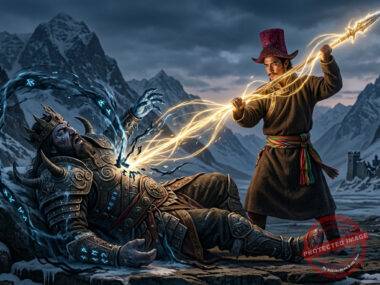
Kesar ultimately kills the King of Hor.
The enemy who had invaded Ling and captured ‘aBruguma has been defeated.
The story has now reached the threshold of its final great conflict.
The Meaning of the Capture
The capture of ‘aBruguma is important because it transforms Kesar’s relationship with warfare.
Earlier battles were often associated with heroic adventure and the defeat of supernatural enemies.
This conflict is different.
Kesar is fighting because his homeland has been invaded and his wife has been taken.
The political and personal dimensions of the epic become inseparable.
The fate of the queen becomes connected with the fate of Ling.
‘aBruguma at the Centre of the Conflict
The story also demonstrates the continuing importance of ‘aBruguma.
She is not simply a character from the early marriage episode.
Her fate drives one of the central movements of the later saga.
Her capture forces Kesar to leave his other adventures behind.
The hero must return to the conflict surrounding Ling.
The woman who entered Kesar’s story through marriage now becomes the reason for his confrontation with Hor.
Kesar’s Return to His Role as King
The disguised Kesar can enter Hor as a worker.
But the conflict ultimately restores him to his identity as king.
He has demonstrated that he can survive without royal ceremony.
He can work with his hands.
He can learn another man’s craft.
He can move through enemy territory unnoticed.
And when the moment arrives, he can once again become the warrior and ruler of Ling.
The episode therefore presents another aspect of Kesar’s heroism.
His power is not dependent upon appearance.
The Hero in Disguise
The disguise also continues a recurring feature of the Kesar tradition.
Kesar can change his outward appearance and move between different social worlds.
Francke’s broader writings describe Kesar as a hero who frequently exchanges his glorious appearance for a much poorer exterior and who can make himself invisible.
This ability is part of the wider epic conception of Kesar.
The king can become a commoner.
The warrior can become a craftsman.
The ruler can enter an enemy’s land without revealing who he is.
From Captivity to Confrontation
The capture of ‘aBruguma begins as a story of separation.
Kesar is absent.
Ling is attacked.
‘aBruguma is taken.
News reaches the hero.
He returns toward the enemy.
He enters Hor in disguise.
He prepares the means to reach the castle.
And finally he confronts the King.
The entire episode therefore moves steadily from loss toward confrontation.
The Winter Myth
Francke’s earlier study of the Kesar mythology places the northern journey, the giant episode, the marriage associated with the giant’s household, and the deliverance of ‘aBruguma from the King of Hor within what he called the Winter Myth of the Kesar Saga.
Francke proposed a seasonal interpretation of these episodes.
That interpretation belongs to his historical scholarship and should not be presented as an unquestionable meaning of the tradition.
For the website, it is useful to distinguish the traditional narrative itself from later scholarly interpretations of what the narrative may symbolise.
Oral Tradition and Variations
The Kesar Saga was transmitted through oral performance and exists in numerous regional forms.
Francke’s Lower Ladakhi version is one documented form of the larger epic.
His 1909 publication divides the saga into a sequence that includes the capture of ‘aBruguma by the King of Hor and, immediately afterward, the defeat of Hor.
Other tellings may alter the order of events, expand particular characters or provide additional adventures.
Modern accounts also record local traditions associated with places connected with Kesar and the King of Hor.
For example, a Ladakh Studies source records a local tradition concerning rTa-nag sga, described as Kesar’s saddle, and associates it with the place where Kesar is said to have turned his horse into stone while fleeing the army of Hor.
Such traditions should be presented as local oral traditions, not automatically as independently verified historical events.
Cultural Context
The Hor episode brings together several major themes of the Kesar Saga:
Separation — Kesar is separated from ‘aBruguma.
Captivity — the queen is taken away from Ling.
Invasion — the conflict affects the kingdom itself.
Disguise — Kesar enters the enemy’s territory without revealing his royal identity.
Craftsmanship — the hero learns the trade of the smith.
Ingenuity — the iron rope becomes a means of overcoming the castle’s defences.
Strength — the final contest with Hor becomes a direct test of the two rulers.
Return — Kesar’s journey ultimately leads him back toward his kingdom and his wife.
These themes connect the personal and political dimensions of the epic.
The King, the Queen and the Kingdom
The story demonstrates how closely connected the lives of rulers are with the fate of their kingdoms in heroic epic.
The King of Hor does not simply capture an individual woman.
He attacks the household of the King of Ling.
The capture of ‘aBruguma therefore becomes an attack upon the social and political order surrounding Kesar.
Kesar’s response is correspondingly larger than a private rescue.
He must confront the ruler responsible.
The Road to the Final Conflict
By the end of this episode, the relationship between Kesar and Hor has reached its decisive stage.
The King of Hor has invaded Ling.
He has captured ‘aBruguma.
Kesar has entered Hor.
He has prepared himself through disguise and craftsmanship.
And he has confronted the King.
The next chapter carries the story into the final major episode of this nine-chapter sequence:
the defeat of the King of Hor.
Versions and Variations
The names associated with the Hor episode can appear in different forms in modern writing.
The first wife of Kesar may appear as:
- ‘aBruguma
- ‘aBrugmo
- Duguma
- Dugmo
- Drukmo
The King of Hor is associated in Francke’s material with Gur-dkar.
These differences partly reflect Tibetan spelling, transliteration and regional usage.
The website therefore retains the source form ‘aBruguma while using Duguma where useful for modern readers.
Source Notes
Primary source
A. H. Francke, A Lower Ladakhi Version of the Kesar-Saga, Calcutta, 1909.
Francke’s contents place “Capture of ‘aBruguma by the king of Hor” on pages 200–242 of the Tibetan text, followed by the abstract of contents, vocabulary and comments on pages 243–255. The following section, pages 256–305, is “Defeat of the king of Hor.”
Francke’s own preface gives the overall sequence as: the prologue, birth of Kesar, wooing and marriage to ‘aBruguma, journey to China and marriage there, journey to the North, capture of ‘aBruguma by the King of Hor, and finally Kesar’s defeat of the King of Hor.
Historical and comparative notes
Francke’s History of Western Tibet gives a concise English summary of the Hor episode, including Kesar’s return after receiving news of the capture, his work with a smith, the iron rope, his ascent to the castle and the final contest with the King of Hor.
Later Ladakhi studies also preserve local traditions associated with places connected to Kesar’s flight from the army of Hor. These are best identified as oral or local traditions rather than treated automatically as historical evidence.
Editorial note
This page is a website-oriented English narrative adaptation based principally on the Lower Ladakhi tradition recorded by A. H. Francke.
The chapter follows the established nine-chapter structure of this website.
The original Francke publication treats the capture of ‘aBruguma and the defeat of the King of Hor as two consecutive major episodes. The present series therefore keeps them as Chapters 8 and 9.
Where later summaries or local traditions provide additional details, they should be distinguished from the core sequence documented in Francke’s Lower Ladakhi version.
The events of the Hor story belong to the epic and oral tradition and should not be presented as straightforward historical documentation.
What Comes Next
The King of Hor has invaded Ling.
‘aBruguma has been taken away.
Kesar has crossed into enemy territory and prepared himself for the confrontation.
The conflict that began with the capture of his wife has now reached its decisive stage.
The final chapter of this nine-part sequence tells the story of Kesar’s defeat of the King of Hor.
There, the struggle between Ling and Hor reaches its conclusion, and Kesar’s long journey toward the recovery of ‘aBruguma and the restoration of his kingdom reaches its final dramatic stage.
The saga now moves from captivity and pursuit to the final defeat of Hor.
Chapter Navigation
Previous Chapter:
Ling Kesar — The Northern Giant
Next Chapter:
Ling Kesar — The Defeat of the King of Hor