 sagi
sagiOn a May morning in Kargil, there was barely enough room for me on the bench.
The tea shop stood on the road between the Polo Ground and T Chowk, one of a row of small places whose paint had already thinned under weather and hands. Some fronts were a tired red; others, a green that had begun to peel. Before work, the room filled quickly. Men sat shoulder to shoulder, eating before going wherever the day required them to go. When I entered, bodies shifted farther along the bench. A space appeared. I took it.

The proprietor was already working. Tea was on. He cracked two eggs into a pan and stirred. Bread came to the table. The table leaned slightly.
Nothing in the room seemed arranged for a visitor’s idea of Kargil. It was arranged for breakfast.
Outside, the town was beginning.
That morning was May 26, 2011. I know the date because I wrote it down. The notebook preserves details memory might have softened: the bench, the workers, the eggs, the bread, the worn paint. More than a decade later, these small facts interest me more than the explanations I once tried to place around them.
The bench was not beautiful. It did not need to be.
A month earlier, on April 17, I had arrived in Kargil and spent the night in a simple one-room apartment. There was a small washing place in one corner, a shared toilet, and a single gas stove. I had slept in many temporary rooms by then, but this one matters in the archive because it marks the beginning of something quieter than arrival.
There was a place to put a bag.
There was a stove.
There was a morning after.
The next day the streets were already busy with students, shopkeepers, men in uniform, laborers. Near the apartment, I entered another tea shop crowded with workers at breakfast and ordered an omelet and bread. The old notes remember the closeness of the room and the mild sweetness of the bread.

Nothing dramatic happened.
People ate and left.
That is how Kargil entered me: not through a single revelation but through repetition.
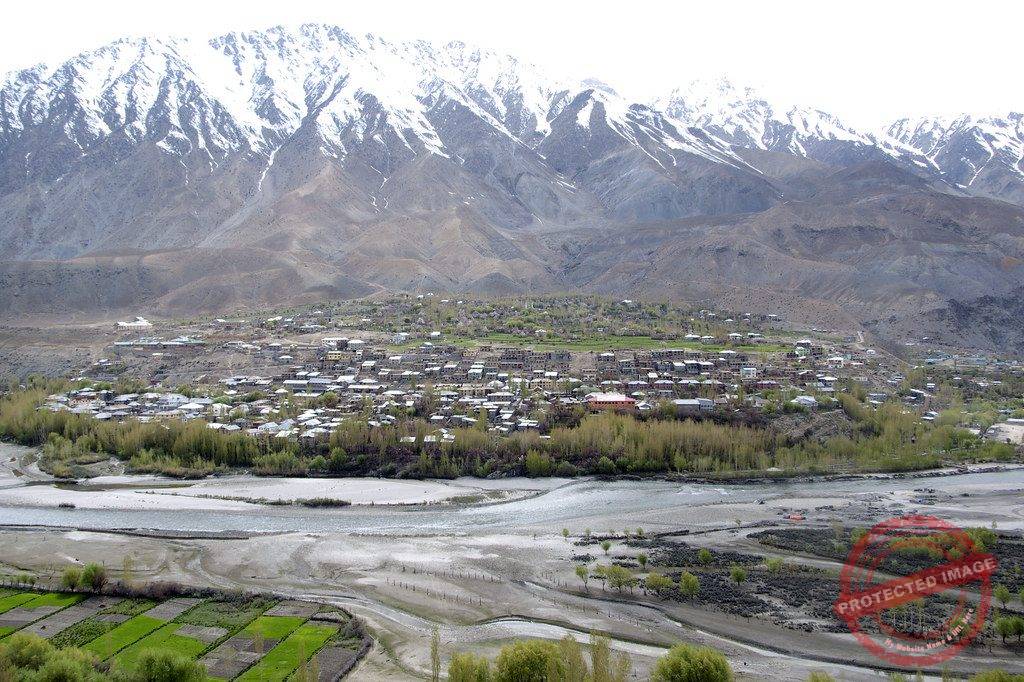
From outside, Kargil is easily made into something larger than itself. It can become a name on a road, a place inside the history of conflict, a district headquarters, a stop between other destinations. Those frames are real. But they can grow so large that a town’s ordinary hours disappear beneath them.
People still have to buy breakfast.
Children still have to get to school.
A shop opens.
Laundry dries.
Someone waits for work.
Someone has time for tea before the next thing begins.
The ordinary does not cancel history. It is where history has to live.
After breakfast, the town widened by increments. The close room opened onto the bazaar, where fruit and vegetables made bright patches along the street. From there, a few minutes of walking could bring me to another tea shop, a junction, a school route, a government office, steps climbing above the commercial streets, or a road running toward the river.

These were not large distances, but they changed the character of the day.
At the tea shop the world was the width of a bench. In the bazaar it became movement: customers, sellers, traffic, people carrying things, people stopping to talk. Above the bazaar, roofs caught sun. Farther out, the density loosened.
I began to know Kargil through these small changes in scale.
The knowledge was physical before it was intellectual. I knew how long a certain walk felt. I knew which part of a route would be crowded. I knew when the morning would still smell of bread. I knew that a turn which seemed minor on a map could change the sound around me.
None of this was expertise.
It was knowledge produced by using a town repeatedly.
That kind of knowledge is easy to overlook because it rarely produces a story on its own. It is made from errands, meals, waiting, returning, and choosing the same road again. It accumulates without announcement.
In May 2011, I began to see another Kargil above the bazaar.
Near Mission School, steps climbed toward higher ground. The commercial streets opened beneath me. On one roof, dyed fibers had been spread out to dry in the early summer sun. On another, beneath laundry, a mother rested with a baby.
The old entry moves past these scenes quickly. I was walking toward something else.
Now they stop me.
From the bazaar, Kargil spoke in the public language of a town: traffic, purchases, food, work, people moving between tasks. A few minutes uphill, other forms of life became visible. Work dried on a roof. Clothes hung in the sun. Someone rested.
I did not know the woman on the roof. I do not know the name of the person whose fibers were drying. I cannot tell you what either thought about that day, Kargil, or the stranger passing with a camera.
The record gives me the outward scene and no more.
That limit is useful.
A place can become familiar long before it becomes fully known. Perhaps it never becomes fully known. You learn routes, faces, timings, habits. You learn which street will be busy in the morning. You begin to know where to eat. But the lives around those habits remain larger than your access to them.

Kargil taught me that difference slowly.
The gaps around those scenes are also part of their shape.
I do not know what happened after I walked away from most of them. I do not know how long the workers stayed at the tea shop, whether the mother on the roof remembered the afternoon, or how many years the old taxi-stand shops remained as they were. The archive is strongest at the instant of observation and weakens beyond it.
That is not unusual. Daily life is mostly unwitnessed by the people who later write about it.
The temptation is to fill the missing space with what seems likely. Probability makes smooth prose. It also makes dangerous history.
So the gaps remain.
By June 2012, another tea-shop scene had entered the archive. Near the old taxi-stand area, two small shops faced a raised strip of concrete. Men came and went through the day. My notes record a changing mix of people connected to different kinds of work and public life: local religious figures, traffic police, government employees, teachers, others passing through.
The people changed. The place remained somewhere to sit.
Waiting rarely looks important in a photograph. Departure has movement. Arrival has consequence. Waiting can look like nothing.
A town knows otherwise.
Someone waits for a passenger. Someone waits for work. Someone has finished one task and has not yet begun the next. Tea fills the interval.
I cannot reconstruct every face from that 2012 scene, and I should not try. What remains is a small public rhythm beside a taxi stand: people occupying time without needing the place to be memorable.
When I think of Kargil now, this is close to what I mean by its ordinary hours: they did not announce themselves as memory while they happened.
The town was made from short distances.
A tea shop to a junction.
A junction to a school.
A flight of steps above the bazaar.
A road that thinned toward the river.
In Ladakh, distance is often imagined through passes, valleys, altitude and hours of driving. Kargil taught me a smaller scale. A town can change atmosphere in a few minutes on foot.
After breakfast on that May morning, the close brown room of tea, egg, bread and bodies opened into the bazaar. Fruit and vegetables made bright patches against the street. Above the market were roofs and houses. Elsewhere were school routes, government offices, shops, transport stands, alleys I began to recognize without looking for a sign.

The nearness of these worlds mattered more than I understood then.
A traveler can cross a great distance and still know very little.
A resident can cross three streets and pass through half a day’s obligations.
My archive records only the first kind of person trying, imperfectly, to notice the second.
By November 2013, repetition had begun to leave a different mark.
One morning I wrote about bread baking in the street and children on their way to school. Tea shops were opening into the day. There were many of them.
I had begun returning to one.
That small sentence contains most of what I want to say about familiarity.
There were many tea shops.
I went back to one.
A shop becomes useful before it becomes meaningful. You know where to sit. You recognize the pace of the person working there. You know what kind of morning you are entering. No ceremony marks the moment when a place stops being new.
Repetition does the work invisibly.
The same 2013 entry contains an even better measure of my relationship with Kargil.
There was a restaurant I visited almost every day.
I did not know its name.
I remembered the owner as warm. A chapati cook worked by the entrance. I knew how to get there. I knew the doorway. I knew some of the people by sight. I knew what it felt like to arrive.
And still I did not know what the place was called.
Almost every day.
No name.
I do not want to turn that ignorance into wisdom. Names matter. They let people and places exist outside our private descriptions. A name can keep a writer from reducing someone to “the owner” or “the cook.”
My failure to learn the name is not a virtue.
But it is accurate.
It describes a particular kind of closeness: practical, repeated, affectionate, incomplete.
The incompleteness matters more to me now than it did then.
A perfect archive would identify every person. Every place would have an address. Every bread would have a settled spelling. Every photograph would carry an exact date and direction. I would know which shops remain and which are gone, which routes changed, who still works where, what has become of the people who happened to enter my frame.
I do not know these things.
There are gaps large enough to walk through.
Some identities were never written down. Some locations are certain only within a small area. The present condition of the old tea shops and the restaurant is not something a notebook from 2011 or 2013 can answer.
Those absences prevent the past from becoming too smooth.
They stop me from pretending that the Kargil in my memory is the Kargil of today. They stop affection from becoming ownership. They make it harder to call Kargil a “second home” as though my feeling created a reciprocal fact.
Kargil could feel like home to me without needing to belong to me.
That difference keeps the memory honest.
What survives most clearly is use.
Paint worn thin where weather and hands had touched it.
A table leaning beneath breakfast.
A bench holding one more person after everyone moved a little.
A room with one stove.
Laundry above the bazaar.
These things carry time without requiring a theory.
Wear is not beautiful because it is wear. A modest room is not morally pure because it is simple. Labor does not become picturesque because someone else is looking at it.
The beauty, if there is any, lies closer to use than deterioration.
Objects had jobs.
Rooms had jobs.
Roads had jobs.
People did too.
By 2013, I was already writing that Kargil seemed to be changing. I noticed more places to stay and shifts around transport and business. That was my perception, not a census and not a judgment about whether change was good or bad.
But it places movement inside the archive.
Even while certain corners were becoming familiar to me, those corners were not waiting for me to understand them.
Kargil continued.
Memory has a habit of freezing a place at the moment we loved it. A photograph helps. It cuts a square out of time and makes the square feel complete. Old writing can do the same. “The tea shop” remains because the paragraph remains. “The road” stays where the sentence left it.
The real place owes nothing to that stillness.
This is why I do not want a present-day reunion forced onto these older scenes. I do not need to stand in the lane now and discover an empty storefront. I do not need the owner of the unnamed restaurant to recognize me, or fail to recognize me, so that the past can acquire a dramatic ending.
If such a scene happens one day, it will need its own truth.
For now, the older Kargil is enough.
The archive stays with workers making room on a bench.
It stays with bread.
It stays with roofs above the bazaar.
It stays beside the taxi stand, where waiting was part of the day’s architecture.
It returns, finally, to the restaurant without a name.
Another Kargil appears in the June 2012 notes, farther from the dense center. The main bazaar gives way quickly to quieter roads. The Suru River is nearby. Vehicles still pass, but the soundscape loosens. At a tiny roadside shop I bought a small carton of orange juice and sat on a slightly tilted bench.
I remember looking at the man running the shop and wondering whether he remained there through winter.
I did not know.
I still do not.
The question survived more clearly than the answer because there was no answer.
It would be easy to make the quieter road more “authentic” than the bazaar, to treat horns and traffic as intrusion and the river as the real Ladakh underneath.
That would be false.
The bazaar full of vehicles was Kargil.
The roadside bench was Kargil.
The packaged orange juice was Kargil.
The river was Kargil.
The ordinary hours contained all of them.
A town is not required to choose one atmosphere for a visitor.
By 2013 I had preferences. They may be among the clearest signs of familiarity. A traveler asks where to go. Someone who has stayed long enough begins simply to go there.
The tea suits you.
The owner is kind.
The bread is the way you like it.
The walk is easy.
You return.
Over time, the return itself becomes the reason.
There was no single day when Kargil changed status for me. No one gave me a key. There was no threshold after which I ceased being an outsider.
Attachment accumulated sideways.
One morning I knew where to eat.
Later I knew another place.
Later still I knew how the town would thin as I walked away from the bazaar.
By 2013, some routes no longer required decisions.
This is quiet knowledge. It cannot be displayed as expertise. It gives no authority over the lives around it.
You recognize a turn before you remember why.
You know the distance between two places in your body.
You expect a smell at a certain hour.
You remember the way people made room.
None of this makes you local.
It may simply mean that repetition has entered the body.
For me, Kargil accumulated in that way.
Not as revelation.
As recurrence.
Even the word ordinary needs care. Daily life is not necessarily gentler or more truthful than public history. It can contain boredom, hierarchy, irritation, exclusion, hurry, kindness, obligation, fatigue—much of which I did not see and could not know.
My archive is not evidence of harmony.
It is evidence that mornings happened alongside everything else.
That is enough.
It leaves Kargil at its own scale: history and breakfast, traffic and quiet, change and memory occupying the same town without resolving one another.
On that May morning in 2011, I finished breakfast and stepped back into Kargil. The town continued without needing to know that I would remember the table.
Years later, I returned again and again to another place, the small restaurant I never properly named.
I can still enter it in memory.
I know which way I am going.
I recognize the entrance before I reach it.
Inside are people I remember incompletely, doing work that was ordinary to them and memorable to me.
I have no signboard to give you.
Only the way there.

 sagi
sagi



 Writer