 sagi
sagiWild Yak in One Minute
The wild yak (Bos mutus) is the wild high-altitude yak of the Tibetan Plateau and adjacent Trans-Himalayan landscapes. It is distinct from the domestic yak, Bos grunniens, although the two are closely related and can interbreed. The IUCN Red List classifies the wild yak as Vulnerable, with a decreasing population trend and an estimated 7,500–9,999 mature individuals. That assessment was made in 2014 and is explicitly marked by IUCN as needing an update, so it should not be read as a fresh global census.
Wild yaks survive in alpine tundra, grassland and cold desert, generally around 4,000–6,100 m according to the IUCN assessment. Their remaining range is concentrated in China, with an important edge population in Ladakh, India. In Ladakh, field studies have repeatedly recorded wild yaks in the Changchenmo Valley of the northern Changthang landscape.
| Scientific name | Bos mutus (Przewalski, 1883) |
|---|---|
| Common name | Wild yak |
| Family | Bovidae |
| IUCN status | Vulnerable (C1); assessment dated 2014, published 2016, marked “Needs updating” |
| IUCN population estimate | 7,500–9,999 mature individuals; trend decreasing |
| Main habitat | Alpine tundra, grassland, high cold steppe and cold desert |
| IUCN elevation range | 4,000–6,100 m |
| Core modern range | Tibetan Plateau in China, with a range-edge population in Ladakh, India |
| Ladakh stronghold | Changchenmo Valley / northern Changthang landscape |
Contents
- What exactly is a wild yak?
- Wild yak vs domestic yak
- How to identify a wild yak
- Wild yak size and weight
- Wild yak habitat
- Where wild yaks live today
- Wild yak in Ladakh: what field studies actually found
- How yaks survive extreme altitude
- Diet and foraging
- Herds, movement and breeding
- Predators: what is known and what is not
- Conservation status and threats
- Seeing wild yak responsibly in Ladakh
- Wild yak FAQ
- Sources and evidence note
What Exactly Is a Wild Yak?
The wild yak is a very large bovine adapted to the thin air, cold temperatures and sparse forage of the Tibetan Plateau and neighboring high-altitude regions. Modern mammal taxonomy commonly treats the wild form as Bos mutus and the domestic yak as Bos grunniens. The Mammal Diversity Database lists Bos mutus as a living wild species in the family Bovidae and describes its distribution as fragmented across the Tibetan Plateau, with one population extending toward Ladakh.
The naming matters because “yak” in everyday language often mixes together two different things: the genuinely wild animal and the domestic yak that has lived with high-altitude pastoral communities for thousands of years. Search results, travel writing and even older scientific literature may use Bos grunniens, Bos grunniens mutus or Poephagus mutus for the wild form. For a current general reference, Bos mutus is the clearest name to use.
Wild Yak vs Domestic Yak
A wild yak is not simply a domestic yak that happens to be living outside a village. Wild and domestic yaks differ in ecology, human association, typical appearance and average body size, although they remain close enough genetically to interbreed.
| Feature | Wild yak | Domestic yak |
|---|---|---|
| Scientific name commonly used | Bos mutus | Bos grunniens |
| Relationship with people | Free-ranging wildlife | Managed livestock |
| Typical distribution | Remote high-altitude Tibetan Plateau and adjacent range edges including Ladakh | Widely kept by high-altitude pastoral communities across the Himalaya and Tibetan Plateau |
| Body size | Generally larger and more massive, especially adult males | Usually smaller, with large variation among breeds and local stocks |
| Coat | Usually dark brown to black with a long shaggy fringe | Can be black, brown, white, piebald or other domestic color patterns |
| Conservation concern | Vulnerable globally; genetic introgression and habitat pressure are concerns | Not a wild conservation unit; important livestock and cultural resource |
Interbreeding is one of the reasons conservationists care about keeping the distinction clear. The IUCN identifies hybridization with domestic yaks as a threat to the genetic integrity of remaining wild populations.
How to Identify a Wild Yak
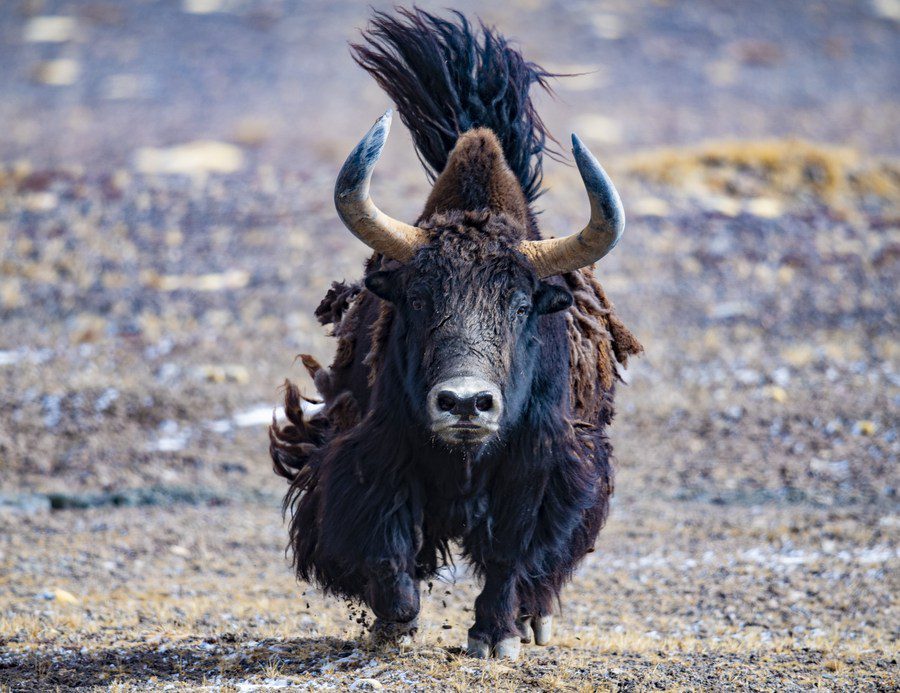
Wild yaks are built like enormous, long-haired cattle, but several features stand out in the field. Adult animals are typically dark brown to black, with a dense undercoat and long outer hair hanging from the chest, flanks and belly. The shoulder region is high and powerful, the tail is long and horse-like, and both sexes carry horns. Adult males are much heavier than females and can look almost disproportionately massive through the shoulders and forequarters.
Horn shape varies with sex and age. Mature males generally carry thicker, more massive horns; females tend to have more slender horns. In the field, body size, horn proportions, herd context and remoteness of habitat are more useful together than any single feature.

How Big Is a Wild Yak?
Wild yak size is one of the most-searched questions about the species, and published figures vary because measurements come from different populations and relatively small samples. A major species account in Mammalian Species and the Handbook of the Mammals of the World report adult males at roughly 535–1,000 kg, with exceptionally large values sometimes reported higher in older literature, and females around 300–350 kg. Reported shoulder height is about 170–203 cm for males and 137–156 cm for females.
The important biological point is not a single record weight but the pronounced sexual dimorphism: an old bull can be dramatically larger than an adult female. That difference also affects how males and female-calf groups use terrain.
Wild Yak Habitat: Grassland, Cold Desert and High Tundra
The best short answer to “what is the habitat of a yak?” is: very high, cold, open country with enough graminoid forage to support a large grazer.
The IUCN describes wild yak habitat as alpine tundra, grassland and cold desert between roughly 4,000 and 6,100 m. The same assessment emphasizes that vegetation can be sparse and that the landscape includes high cold steppe, not just lush alpine meadow. Grasses, sedges, forbs and low shrubs dominate the vegetation. Wild yaks can move seasonally, using lower valleys in winter.
This corrects an oversimplification that appears in many summaries: wild yaks do not simply avoid barren-looking steppe. They occur across a mosaic of alpine meadow, steppe and cold-desert habitat, with local use shaped by forage, water, disturbance, snow and season.
Research in Ladakh reinforces that point. The Wildlife Institute of India study area in northern Changthang included moist and mixed meadows, desert steppe and scrub steppe. Within Changchenmo, wild yaks were especially associated with the eastern valley and areas with greater cover of graminoids such as Carex moorcroftii, Stipa purpurea and Leymus secalinus.
Where Do Wild Yaks Live Today?
The wild yak’s modern stronghold is the Tibetan Plateau. The IUCN records extant resident populations in China and India, with major Chinese populations in or around the Chang Tang, Arjin Shan, Kekexili/Hoh Xil and adjacent high plateau landscapes. In India, the species is known from Ladakh.
Nepal requires careful wording. The current IUCN entry still lists Nepal as Presence Uncertain because its global assessment dates from 2014. However, a peer-reviewed 2021 study combined field evidence and phylogeographic analysis and argued that Upper Humla contains Nepal’s last wild-yak refuge. The responsible way to present this is not to say either “Nepal is definitely extinct” or “rediscovery is settled beyond doubt,” but to explain that newer evidence post-dates the older IUCN assessment.
A 2024 habitat-priority study modeled more than 900 occurrence records across the Tibetan Plateau and estimated that about 30.79% of modeled wild-yak habitat lay outside protected areas. The study identified habitat fragmentation, infrastructure and pasture fencing as important connectivity risks and highlighted the western Tibetan Plateau connection toward Ladakh as part of the wider conservation landscape.
Wild Yak in Ladakh: What Field Studies Actually Found
Ladakh is not a footnote in the species story. The Changchenmo Valley, in the northern part of the Changthang landscape, is one of the best-documented Indian areas for wild yak. But the numbers often quoted online come from different surveys and should never be merged into a single “current population” figure.
Wildlife Trust of India surveys, 2005–2006
A Wildlife Trust of India survey recorded 79 wild yaks in four herds in 2005 and 22 wild yaks in seven herds in 2006 in Chang Chenmo. Direct sightings were made between about 4,705 and 5,300 m. Using indirect evidence and information from local herders, the survey authors suggested that roughly 200–225 wild yaks might have been present in the wider area at that time.
Those are historical field results, not a present-day census.
Wildlife Institute of India study, 2007–2009
A separate Wildlife Institute of India study covered more than 3,100 km² in northern Changthang, with intensive work around Phobrang and Changchenmo. Researchers monitored 503 km of trails and estimated 110–120 wild yaks in Changchenmo Valley. They found wild yak concentrated in parts of the eastern Changchenmo Valley and identified rangeland degradation, possible genetic contamination from domestic yak, small fragmented ungulate populations and management constraints among the conservation concerns.
The WTI and WII estimates differ because the studies used different periods, field effort, observations and inference methods. They are valuable as snapshots of a difficult borderland population, but they should not be treated as interchangeable or current.

How Can a Yak Live Above 4,000 Metres?
Yak biology is a classic example of adaptation to cold, hypoxia and poor forage. Thick outer hair and a dense insulating undercoat reduce heat loss. A compact body and powerful limbs suit exposed terrain. Physiological and genomic studies of yaks have also found adaptations associated with oxygen stress and energy metabolism.
A 2012 Nature Genetics study comparing the yak genome with cattle found enrichment in gene families and pathways associated with hypoxic stress, energy metabolism and sensing the environment. A 2022 Nature Communications study using chromosome-level genomes from both wild and domestic yak further investigated the genetic and cellular mechanisms behind high-altitude adaptation.
Those genomic results do not mean that every visible trait can be traced to a single “high-altitude gene.” Adaptation is a system: respiratory physiology, circulation, metabolism, insulation, foraging ability and behavior all work together.
What Do Wild Yaks Eat?
Wild yaks are large grazing ruminants. The IUCN summarizes their diet as mainly grasses and sedges, with some forbs. Detailed studies from the Tibetan Plateau also record seasonal use of other plant material, but grasses and sedges are the core of the diet.
Because forage quality changes sharply with altitude, snow and season, movement is tied to food availability. In winter, access to exposed low vegetation can matter as much as total plant biomass. Their broad muzzle, rough tongue and grazing anatomy allow yaks to crop short vegetation efficiently.
Herds, Seasonal Movement and Breeding
Wild yaks are gregarious, but herd structure changes with sex, season and location. The IUCN notes that groups of 10–20 are common and aggregations of more than 100 can occur. Older males are often solitary or travel in small groups of roughly two to five, while females and young are more likely to form larger herds.
Ladakh field observations show why universal “average herd size” claims are misleading. In the WTI Chang Chenmo survey, the largest herd recorded in 2005 contained 57 animals, while the following year produced more groups but fewer animals observed overall.
Published accounts place the wild-yak rut mainly in late summer, with calving the following spring. Much of the detailed reproductive biology is inferred from domestic yak or from limited wild observations, so precise timings should be treated as regional rather than universal. A major species review reports gestation around 258–270 days and notes that wild females generally produce a single calf, often at intervals longer than one year.
What Preys on Wild Yaks?
This is a good example of a question where confident internet answers often exceed the evidence. Wolves and brown bears can prey on or scavenge yaks, but separating wild-yak remains from domestic-yak remains is difficult in regions where both occur. Published reviews explicitly describe predator–prey dynamics for wild yak as poorly known.
Snow leopards are well documented taking domestic livestock, including young domestic yaks in some regions, but that is not the same as proving that adult wild yak are a regular snow-leopard prey species. A cautious summary is more accurate: healthy adult wild yaks are formidable animals; calves, juveniles, weakened animals and carcasses are more plausible targets for large carnivores and scavengers.
Is the Wild Yak Endangered?
The precise answer is: the wild yak is currently listed by the IUCN as Vulnerable, not Endangered. The assessment uses criterion C1 and estimates fewer than 10,000 mature individuals with a continuing decline. However, that global assessment is old enough that IUCN itself marks it “Needs updating.”
The major conservation pressures are not one single threat:
- Past and local poaching: hunting historically drove severe declines in parts of the range, although enforcement has reduced the pressure in some areas.
- Competition and displacement by livestock: wild yaks have limited tolerance for disturbance and can be pushed out as grazing intensity increases.
- Hybridization with domestic yak: gene flow can erode the genetic distinctiveness of small wild populations.
- Habitat fragmentation: roads, fencing and other infrastructure can reduce landscape connectivity.
- Human–wild yak conflict: wild bulls may mix with domestic herds or take domestic cows into wild herds, creating losses for pastoralists and a risk of retaliation.
- Disease risk: transmission from domestic livestock is a plausible concern, but the IUCN notes that this has not been adequately documented for wild yak.
- Climate-related stress: newer conservation work highlights changing vegetation, invasive species and climate pressure as emerging concerns across the high plateau.
A 2026 review calling for stronger Himalayan conservation coordination emphasizes genetic introgression, habitat degradation, forage competition, poaching and climate-linked pressures. Because the species crosses political and ecological boundaries, long-term conservation also depends on connectivity between protected landscapes rather than isolated reserves alone.
Why Wild Yaks Matter Ecologically
A wild yak is not only a charismatic large mammal. It is also a major grazer in a low-productivity high-altitude ecosystem. Grazing, trampling, nutrient movement and seasonal movement can influence plant communities and habitat structure. Older ecological literature even notes links between yak grazing and habitat used by other plateau species.
For Ladakh, the species is especially important because it represents the eastern, high-plateau character of Changthang: cold desert, sedge and grass communities, kiang, chiru, argali, blue sheep, wolves and other animals sharing a landscape where relatively small changes in disturbance can have large consequences.
Can You See a Wild Yak in Ladakh?
Yes, wild yak occur in Ladakh, but this is not a species that should be marketed as a guaranteed roadside sighting. The best-documented Indian population is associated with the remote Changchenmo / northern Changthang landscape, where access can be influenced by wildlife protection, border security and permit conditions.
For responsible wildlife travel, three rules matter:
- Never approach, surround or deliberately drive an animal for a photograph.
- Use binoculars or a long lens and give herds an obvious escape route.
- Follow current local access rules rather than treating an old trip report as a permit guide.
A large bull can be dangerous at close range, especially if surprised or during the breeding season. Distance is both an ethical wildlife practice and a safety measure.

Wild Yak FAQ
- What is the scientific name of the wild yak?
- The accepted scientific name commonly used today is Bos mutus. The domestic yak is generally referred to as Bos grunniens.
- Where do wild yaks live?
- They live mainly on the Tibetan Plateau in China, with a range-edge population in Ladakh, India. The current IUCN assessment lists Nepal as uncertain, while newer research supports a surviving population in Upper Humla.
- What is the natural habitat of a yak?
- For wild yak, the natural habitat is high-altitude alpine tundra, grassland, cold steppe and cold desert. The IUCN gives a typical elevation range of about 4,000–6,100 m.
- Are yaks wild animals?
- Some are. Wild yak are wildlife (Bos mutus), while millions of domestic yaks (Bos grunniens) live with pastoral communities. “Yak” by itself can refer to either, so context matters.
- How big can a wild yak get?
- Published species accounts put adult males roughly in the 535–1,000 kg range, with reported shoulder heights around 170–203 cm. Females are substantially smaller, commonly around 300–350 kg in published summaries.
- Is the wild yak endangered?
- It is listed as Vulnerable by the IUCN, one category below Endangered. The IUCN assessment is dated 2014 and marked as needing an update.
- How many wild yaks are left?
- The IUCN assessment estimates 7,500–9,999 mature individuals globally. Because that assessment is old, it should be cited as an IUCN estimate rather than presented as a 2026 census.
- Are wild yaks found in Ladakh?
- Yes. Field studies by Wildlife Trust of India and the Wildlife Institute of India documented wild yaks in Changchenmo Valley. Historical surveys produced different estimates, including 110–120 animals in a 2007–2009 WII study. These figures are historical study results, not a current Ladakh census.
- What do wild yaks eat?
- Mainly grasses and sedges, with some forbs and other plant material depending on season and location.
- What is the biggest threat to wild yak?
- There is no single modern threat everywhere. Important pressures include habitat disturbance and fragmentation, competition with livestock, genetic introgression from domestic yak, local conflict and historically severe poaching.
- Can wild yaks breed with domestic yaks?
- Yes. That compatibility is biologically important, but in conservation it creates concern because repeated hybridization can reduce the genetic distinctiveness of small wild populations.
Sources and Evidence Note
This guide deliberately separates current status from historical field counts. Population figures from Ladakh are dated to the survey periods that produced them, and the IUCN global estimate is identified as an older assessment rather than a live census.
Editorial note: This page avoids unverifiable testimonials, avoids treating disputed or dated population numbers as current facts, and distinguishes strong evidence from plausible but poorly documented claims.


 Writer