 sagi
sagiKeeping the Village, a Village: Inside Phyang’s Zero-Waste Experiment
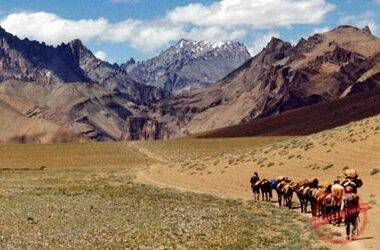
Beyond Phey, the road climbs over a small pass before opening briefly toward the Ladakh Range. From there the land looks stripped back to its essentials: brown earth, exposed slopes, long distances and mountains standing beyond the valley. The road then drops toward the entrance to Phyang, where a large gate marks the beginning of the village.

Suman Tiwari was waiting there.
She had come to Ladakh from Rishikesh, and she had invited LIFE on the PLANET LADAKH to see the work of Vikrit Se Prakrit Foundation in Phyang. After we greeted each other, she climbed onto the back of my scooter and we rode through the gate together.
The first thing I noticed was not something that was there. It was something that seemed to disappear.
Along parts of the main road before the gate, litter was visible. Once we entered Phyang and began climbing into the village, I kept looking at the roadside and the spaces between houses. There was remarkably little rubbish on the ground.
That does not make Phyang a zero-waste village. The project is still unfinished, and some forms of waste remain difficult even when they are carefully separated. But the contrast was enough to change the way I looked at the rest of the day. I had come to see a waste-management project. I began instead to watch how a village was learning to see its own waste.
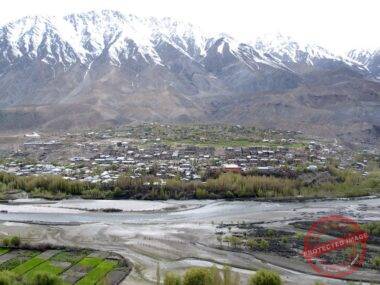
Phyang is not a compact settlement that can be understood from one street. Suman described it as a long village stretching through very different zones, from the highway side toward higher and more sparsely settled ground. Project documents place its population broadly between about 3,000 and 3,500 people, with roughly 500 to 600 households depending on the source and survey frame. The variation itself is useful: Phyang is large enough, dispersed enough and economically mixed enough that no single bin, truck or cleanup can solve its waste problem.
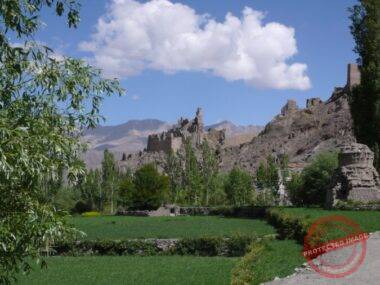
At first we rode through open land where the chocolate-coloured soil lay bare. Then the landscape changed. Trees began to gather around the road. We passed into a green interior, and houses appeared among groves and fields rather than in a tight line. In the centre of Phyang, homes seemed to sit inside the landscape instead of on top of it.
That beauty is part of the problem the project is trying to solve.
A village like Phyang has long had its own cycles of use. Food scraps can feed animals. Organic matter can return to fields. Objects are repaired, reused or kept. The Foundation’s household work found that wet and dry waste were often already separated in daily life, not because residents had adopted a modern municipal system, but because organic material still had local uses.
Modern packaging does not fit those older cycles so easily.
Plastic bottles, multilayer packets, Tetra Pak cartons, sanitary products, contaminated plastics and synthetic materials arrive in a landscape that never evolved a traditional place for them. An apple can disappear back into the local cycle. A laminated snack packet cannot.
That difference stayed with me later in the day.
Our first important stop was a school where Vikrit Se Prakrit Foundation has been working with children on waste segregation. The lesson was visible before anyone explained it. Students had different places for different kinds of waste, and the act of throwing something away required a small decision: what is this, and where should it go?

The project has introduced students to waste generation, reduction, reuse, segregation and responsible disposal. At Government High School Phyang, a segregation bank allows those ideas to be practised rather than left in a textbook. The Chief Education Officer in Leh has also formally permitted waste sensitisation and waste-management activities at Government Middle School Mankhang and Government High School Phyang.
It is easy to make environmental education sound larger than it is. What I saw was small: a child holding waste, choosing a bin, and putting it in the right place.
That is exactly why it may matter.
A system becomes durable when it stops feeling like a campaign. If children grow up sorting waste as an ordinary part of school life, the village may not have to persuade them to begin twenty years later. Knowledge can move from the classroom into homes, and eventually from one generation to the next.
Outside the school, the same lesson had moved onto the walls.

Vikrit Se Prakrit Foundation has painted waste-awareness messages in several parts of Phyang. At the school, a No Waste painting and other slogans turned the wall itself into a teacher. The messages did not remain inside a meeting, a training session or an NGO document. They became part of the route children and adults pass every day.

We left the school and continued farther into the village.
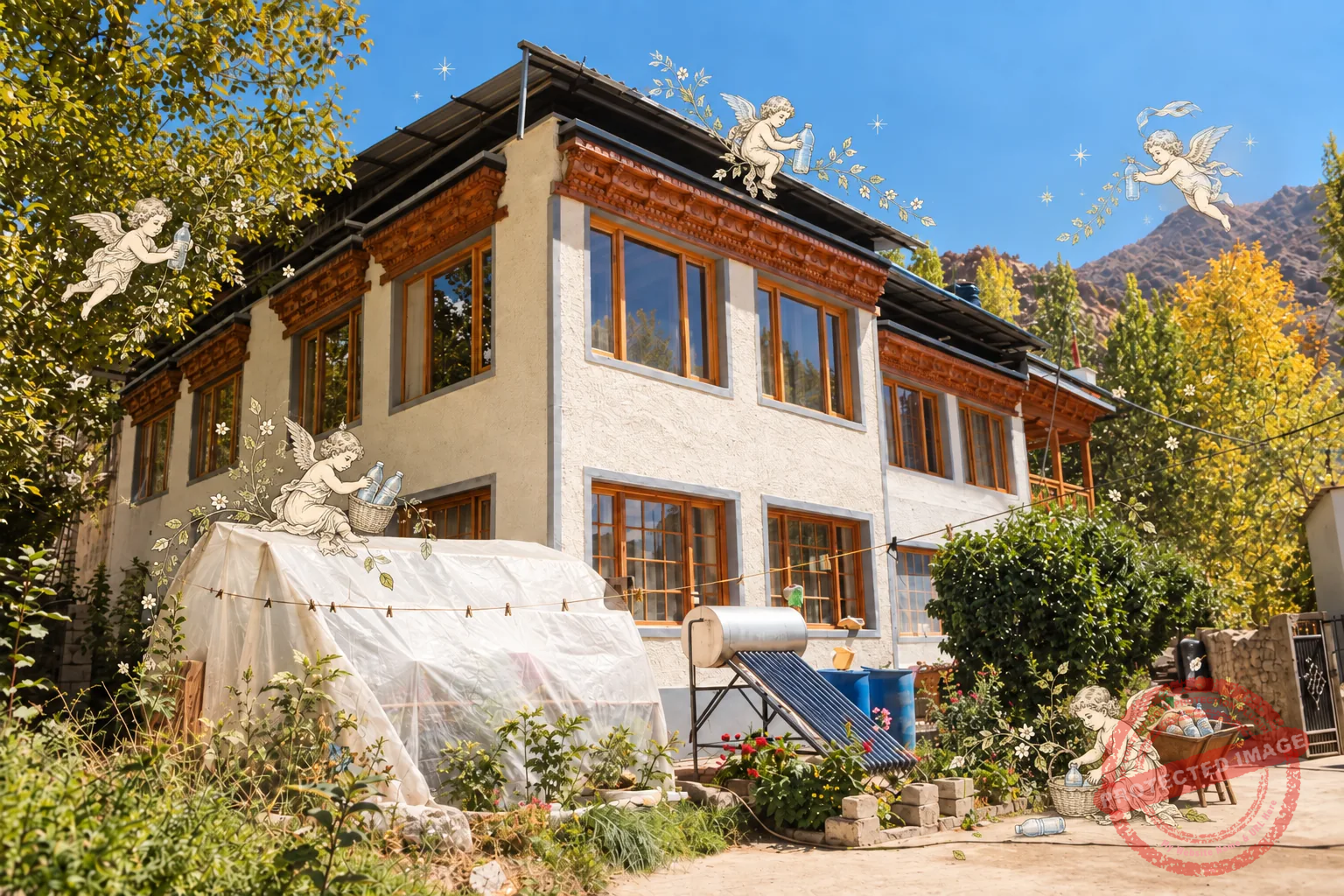
The road moved through deeper greenery until we reached the Foundation’s office. Calling it an NGO office makes it sound more formal than it felt. The current office occupies a room in a traditional Ladakhi house. A new office is under construction nearby, but the place where the work is being done now sits among trees, fields and cultivated land.

Beside the house, apples were growing.
Late September is apple season here. I picked one from the tree and ate it. The sweetness filled my mouth as we stood in a village talking about plastic, recycling, transport costs and the things that cannot easily be returned to the land.
The apple made the whole problem suddenly simple.
It came from this place. What remained of it could return to this place.
Much of the waste that now reaches Phyang cannot.
From April to June 2026, the Foundation surveyed 200 households to understand that new material stream. Its current figures put average household dry-waste generation at around 3.5 kilograms a week. After adding waste from institutions, shops, homestays, highway establishments and registered industries, the project estimates roughly 120 to 125 metric tonnes of dry waste a year across the surveyed area.
The Foundation divides that total into roughly 84 to 90 tonnes of higher-value recyclable material and around 35 to 40 tonnes of lower-value recyclable or non-recyclable waste. PET, HDPE, polypropylene, metals, paper and e-waste may retain recoverable value. Sanitary waste, contaminated plastics, mixed textiles and other difficult materials are much harder to deal with.
The numbers matter, but they do not explain the problem by themselves. Geography does.
A plastic bottle may be recyclable in Delhi or Punjab. That does not mean it is easily recyclable in Ladakh. There is limited downstream recycling infrastructure within the region, so recovered material often has to travel a very long distance before it reaches a processor or buyer.
Vikrit Se Prakrit’s own research says some higher-value recyclables in Ladakh are sold at rates 50 to 80 percent below market rates available elsewhere in India. The Foundation links much of this loss to distance, transport and weak market connections. The exact economics vary by material, but the underlying reality is hard to avoid: in Ladakh, “away” is very far away.
This changes the meaning of a rubbish bin.
For a traveller, throwing away a bottle can feel like the end of a small story. In a Himalayan village, it can be the beginning of a chain involving a household, a collection vehicle, workers, a segregation centre, storage, baling, transport and finally a recycler hundreds of kilometres away.
Someone has to pay for every link.
That is why the Phyang project is not only about cleanliness. It is about whether the system can function after the enthusiasm of a cleanup day has faded.
A collection vehicle needs fuel. Workers need to be paid. Machinery needs maintenance. Recyclables need to be stored until enough material is available to move. If waste reaches the centre mixed together, workers must spend more time separating it, and contamination can reduce the value of material that might otherwise have been sold.
Source segregation therefore becomes economic as well as environmental.
The cleaner the recyclable stream is when it leaves a household, the less labour is required later. Regular user fees can help support collection. Better market links can improve the value recovered from material. None of these measures is dramatic on its own. Together they decide whether the system survives.
One of the most interesting things about Phyang is that many of the physical pieces already exist.
The village has government-supported waste-management infrastructure. Vikrit Se Prakrit Foundation has been working with the Ladakh Renewable Energy Development Agency and the Rural Development Department toward using that existing infrastructure rather than building a parallel private system. Project plans include regular collection, sorting, weighing, baling, storage, record keeping and stronger links with recycling markets.
LREDA had already issued a no-objection response for the Foundation’s survey in Phyang and offered technical input where needed.
So the question here is not simply whether someone can build another waste centre.
It is whether the pieces already on the table can be connected.
We continued uphill.
The houses became more scattered. At the edge of another part of the settlement, a small building carried another No Waste painting. Farther up, near what Suman described as the top of the village, we reached a community meeting place. Its wall carried the message too.


By then I had begun to understand the paintings differently.
They were not decoration around a technical project. They were part of the infrastructure.
A truck can collect waste, but it cannot make a household care about segregation. A building can store plastic, but it cannot make a child understand why a clean bottle has more value than a contaminated one. A wall cannot do those things alone either, but a message repeated at the school, along village routes and at a community building can make waste difficult to ignore.
Phyang’s social structure matters just as much as its roads.
The village contains nine mohallas, each with its own local relationships and representatives. The Goba provides another point of connection. But modern waste does not stay inside traditional social boundaries. New residents, highway businesses, shops, restaurants and industrial units may contribute to the waste stream without belonging to the same networks that historically organised village life.
There are also spaces that feel as if they belong to nobody.
Land between settlements, hillsides and secluded corners can become convenient places for rubbish to disappear from immediate view. During its mapping work, the Foundation identified about sixteen legacy-waste sites around Phyang: places where waste had accumulated before a regular system could deal with it.
The Foundation reports that nine of those sites showed clear improvement after community cleanup work, and that its first large cleanup drew participation from around 90 percent of households. Those are project-reported figures rather than a final measure of success, but they point toward the central difficulty: the waste already on the land has to be dealt with while the village simultaneously builds a system for the waste that will be generated tomorrow.
This is where the phrase “zero waste” can become misleading if taken too literally.
Phyang is not free of waste. Difficult materials have not magically acquired local recycling markets. Sanitary waste does not become easy because it is separated. Multilayer packaging does not become valuable because it is clean. Glass may be recyclable in principle while still lacking a practical route out of Ladakh.
The project is more interesting when those imperfections remain visible.
A perfect village would make a weak story because perfection would hide the real work. Phyang is useful precisely because it shows the friction between aspiration and material reality.
The next stop made that even clearer.
We went to Phyang Monastery.

In Ladakh, a monastery is not only a religious monument or a place visitors photograph. It is part of the social architecture of the village. Vikrit Se Prakrit Foundation included the relationship between villagers and the monastery in its community study because a village-wide system cannot be built only through administrative channels.
At the monastery, waste was being separated too.

Again, it was a small observation. Different waste had different places. But by that point in the day I had seen the same habit repeated across institutions with very different roles: school, community spaces and monastery.
A project becomes more interesting when its message is no longer confined to the people running it.
Suman had explained that before this work began, segregation was not an ordinary village habit and rubbish could be seen in many places. During our ride, the ground told a different story. I did not see a village without waste, but I did see a village where litter was far less visible than I had expected from the road outside.
That distinction matters.
Cleanliness can be staged for a visit. Habit is harder to stage across a long village.
The school bins, the painted walls, the community spaces, the monastery and the cleaned ground all suggested a change that had begun to spread beyond a single cleanup event.
The Foundation is also trying to involve people who already move through the social life of the village, including ASHA and Anganwadi workers. It has discussed deeper participation by women-led self-help groups and has floated a longer-term idea for a zero-waste café linked to a local AMA Group. These plans are still developing, but they show a useful direction: waste management has to become part of livelihoods and daily routines rather than remain an external service delivered to passive residents.
The hardest question, though, is not whether Phyang can become cleaner.
It is whether the village can continue the system when the NGO is no longer doing the pushing.
This may be the most unusual measure of success in Suman’s plan.
Vikrit Se Prakrit Foundation does not intend to remain in Phyang forever. The organisation describes Phyang as its first village. Once the system is working more independently, once segregation is normal, once local structures can sustain collection and responsibility, the intention is to take what has been learned and move to another village.
Not to copy Phyang exactly.
A second village may have different geography, different social relationships, different businesses and a different waste stream. The useful thing to carry forward is not a rigid template but the method of looking closely enough to understand what a place already has before deciding what it needs.
In that sense, the project’s eventual success would contain a paradox.
The NGO would become less visible.
Its departure would be evidence that the village had absorbed the work.
That idea changed how I thought about the painted walls. At first they looked like signs of the organisation’s presence. Perhaps their deeper purpose is to remain meaningful after that presence has faded.
The same is true of the children at school.
If a student has to be reminded forever which bin to use, the lesson has failed. If the student eventually stops thinking about it because segregation has become ordinary, the lesson has succeeded.
The same is true of the monastery.
The same is true of the household.
The same is true of the village.
There is another reason Phyang matters beyond its own boundaries. Environmental education in Ladakh is often forced to explain local problems through examples developed for other parts of India. But a high-altitude cold desert has its own logic. Water is scarce. Winter limits movement. Settlements are dispersed. Transport is expensive. A recyclable material can become almost worthless because the nearest viable market is so far away.
The Foundation has proposed bringing academic attention to those local realities so that environmental learning can be connected to the places children actually know. That larger educational work is still developing, but the principle is already visible at the school: the village itself can become a classroom.
For travellers, the lesson is uncomfortable in a useful way.
Visitors often experience waste only for the few seconds between finishing something and finding a bin. After that, the material leaves our attention. In Ladakh, the landscape makes that disappearance deceptive.
There is no true “away.”
A bottle still has to move through the mountains.
A packet still has to be handled by someone.
A contaminated material still loses value.
A sanitary product still requires a safe final pathway.
A village still has to decide who pays.
Responsible travel in a place like Ladakh therefore begins before littering. It begins with what we carry in, what we consume, what we can refill, what we can avoid, and whether we respect the separation system of the place that must handle what remains after we leave.
By the time we came down from the upper parts of Phyang, the day had arranged itself in my memory as a sequence of ordinary things.
A small pass beyond Phey.
The Ladakh Range.
A large gate.
Suman waiting there.
My scooter carrying us into the village.
Bare chocolate-coloured earth giving way to trees.
Houses among green fields.
Children choosing different bins.
Words painted on a school wall.
A traditional Ladakhi house serving as an NGO office.
A new office still under construction.
Fields beside it.
An apple pulled from a tree.
Another painted wall farther uphill.
A community building near the top of the village.
Phyang Monastery.
Waste separated there too.
None of those things is the solution.
Together, they begin to look like one.
The Foundation sometimes describes rural Ladakh’s waste system as an unfinished jigsaw puzzle. The image works because Phyang already possesses many of the pieces: households, local representatives, government infrastructure, a collection system to be operationalised, workers, schools, public institutions, recyclable material and potential markets beyond Ladakh.
The difficulty is not always the absence of pieces.
It is the absence of connections between them.
Household to collection vehicle.
Collection vehicle to segregation centre.
Segregation centre to recycler.
Child to household.
Mohalla to village.
Monastery to community.
Government asset to daily operation.
Waste producer to financial responsibility.
And eventually, Phyang to the next village.
Vikrit Se Prakrit Foundation uses a simple phrase for its wider mission: “Keeping the village, a village.”
After spending the day there, I understood that phrase differently.
It does not mean keeping Phyang unchanged.
That is impossible.
Roads, packaged goods, tourism, businesses, new residents and consumer materials have already altered the village economy. Refusing change will not make plastic disappear.
The question is whether Phyang can change without surrendering the relationships and landscape that make it a village.
Can a modern waste system be built around existing community structures rather than replacing them?
Can schoolchildren learn environmental responsibility from their own surroundings rather than from distant examples?
Can government infrastructure become useful through local participation rather than simply existing as infrastructure?
Can the village recover enough value from its recyclable waste to help support the people who manage it?
And can an NGO do its job well enough that, eventually, it is no longer needed there?
The project is not finished. That should be said plainly.
Phyang is not yet a zero-waste village.
Some materials still have no satisfying downstream route. The economics remain difficult. The institutional arrangement is still being built. Behavioural change is uneven by nature, because villages are made of people, not programmes.
But something has already shifted.
When I passed through the gate that morning, the first evidence was an absence: less rubbish on the ground.
By the end of the visit, that absence had acquired a structure.
It was connected to a child deciding between bins, a wall carrying a message, a community cleaning old dumping sites, a monastery separating waste, an office working from a traditional house, a government facility waiting to become fully operational, and a woman from Rishikesh planning for the day when her organisation can leave Phyang and begin again somewhere else.
Perhaps that is how a cleaner Ladakh would actually happen.
Not through one enormous solution descending on the Himalaya.
Through one village learning how to carry the weight of what it throws away, then passing the lesson onward.

 sagi
sagi


 Writer